


If you're just starting out, a good rule of thumb for a traditional cup of matcha is to begin with 2 grams of powder (that's about one level teaspoon). Fancy something richer, more like the thick koicha served in ceremonies? Simply double it to 4 grams. Getting these simple ratios right is the secret to a perfect brew, whether you’re whisking up a classic tea or a creamy latte.
Your Quick Guide to the Perfect Matcha Ratio

Honestly, figuring out the right amount of matcha for your cup isn't about rigid rules. It’s more about your personal taste and what you're making. Think of it like your morning coffee – some of us crave a powerful espresso shot, while others prefer a long, milky flat white. The same thinking applies to matcha.
The biggest decider is often the grade of your matcha. A top-notch ceremonial grade has such a nuanced, delicate flavour that you really don't need much. On the other hand, a good culinary grade is designed to be more robust, its flavour bold enough to stand up to milk, sweeteners, and other ingredients.
A Starting Point For Your Brew
To take the guesswork out of your daily matcha moment, we’ve put together a simple reference guide. It covers the most common ways to prepare matcha, with measurements in grams, teaspoons, and the traditional bamboo scoops (chashaku).
A quick tip from us: If you want absolute consistency, a small digital scale is your best friend. A teaspoon measurement can be a bit hit-or-miss depending on how you scoop, but grams are always spot-on.
It's no surprise that matcha powder is becoming so popular. Here in the UK, the matcha market brought in USD 61.8 million and is expected to hit USD 98.3 million by 2030. That’s a lot of us enjoying its unique flavour! You can read more about the UK matcha tea market on Market Research Future.
This guide is here to help you find your ideal ratio, so every single cup you make is balanced, full of flavour, and just how you like it.
Why You Need Different Ratios for Ceremonial and Culinary Matcha
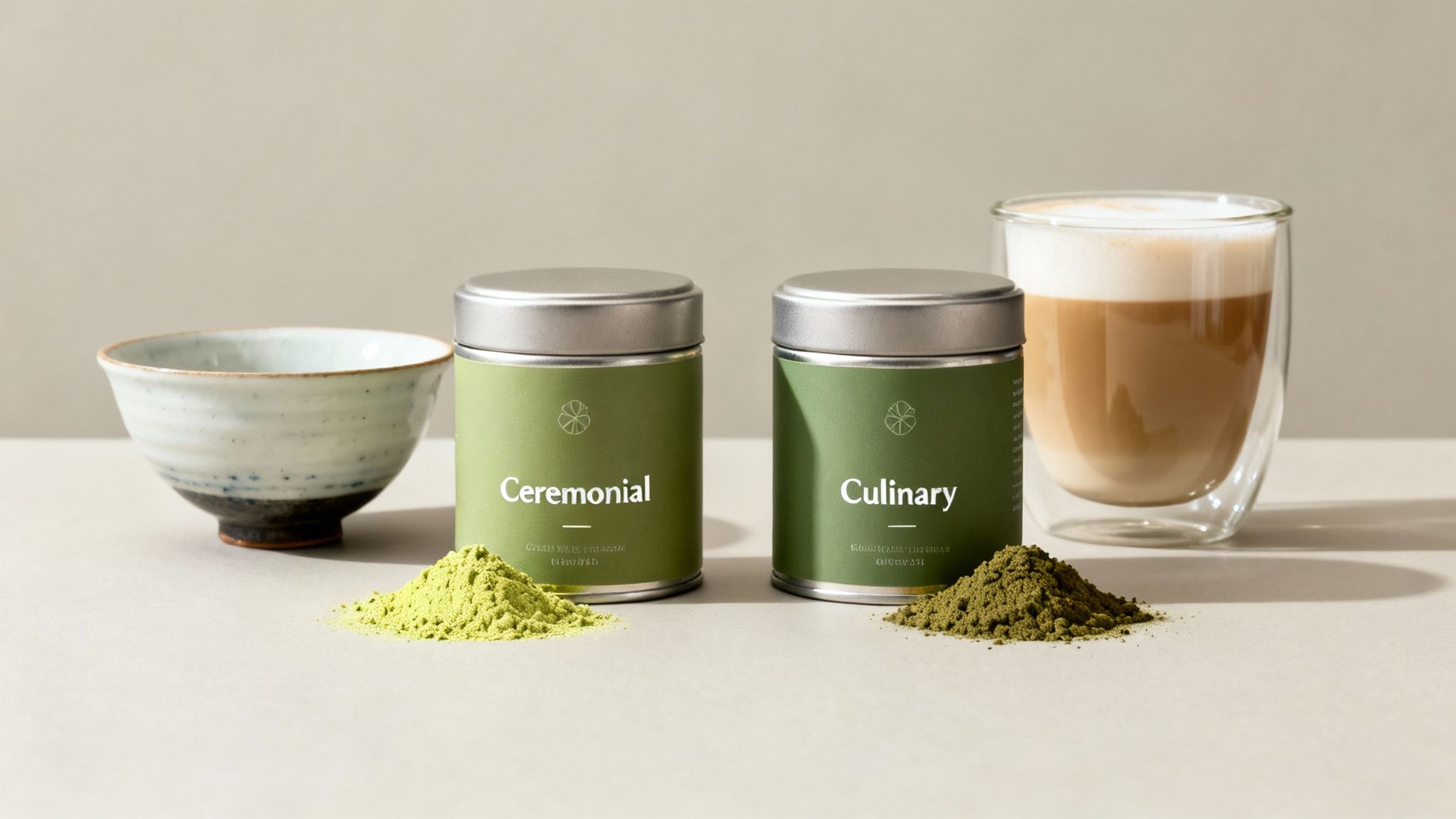
Before you even think about scooping, it's worth knowing that not all matcha is created equal. The difference between ceremonial and culinary grade isn't just marketing speak; it's a genuine guide to its flavour, intensity, and how much you should use. Treating them the same is a bit like using a delicate, single-origin coffee bean for a frothy cappuccino—you’d lose all those beautiful, subtle notes in the milk.
Ceremonial grade matcha is the cream of the crop, made from the youngest, most tender tea leaves. They’re carefully stone-ground into a silky, almost electric-green powder. Its flavour is incredibly delicate, with a natural sweetness and that deep, savoury umami richness we all love. For this reason, less is definitely more.
If you go too heavy-handed with ceremonial matcha, you’ll just overwhelm your palate. The real art is in coaxing out its nuanced character, not drowning it. Think of it as a quiet morning ritual where every sip reveals a new layer of flavour. For a standard cup of Usucha (thin tea), you’ll want to stick to a precise 1 to 2 grams of powder. That small amount, whisked into hot water, creates a perfectly balanced and invigorating brew that does justice to the quality of the leaves.
The Bold Character of Culinary Matcha
On the other hand, culinary grade matcha has a completely different job to do. It’s made from slightly more mature leaves, which gives it a much stronger, more robust flavour with a touch of bitterness. This isn't a flaw; it's a feature. Its bold character is designed to cut through other ingredients, whether that’s milk, sweeteners, or flour in a cake.
Picture yourself baking a batch of matcha cookies or blending a vibrant green smoothie. A mere two grams of culinary matcha would be totally lost, its flavour barely a whisper.
To make an impact, you need a more generous hand. For a rich matcha latte, for example, you might start with 4 grams (about two teaspoons) and adjust from there. This larger quantity ensures the distinct, earthy flavour of matcha really shines through, giving you the colour and taste you're after.
Knowing the different types of matcha tea is the key to getting your ratios right every time. To put it simply:
- For a serene, traditional tea: Use 1-2 grams of ceremonial grade to appreciate its delicate sweetness and complexity.
- For a creamy, flavourful latte: Use 3-4 grams of culinary grade to make sure the matcha isn't overpowered by milk and sugar.
- For baking and cooking: The amount can vary wildly, but a good starting point is often one tablespoon (around 6 grams) or more for a batch of muffins or cookies.
Ultimately, the grade of your matcha dictates how much you use per cup. Ceremonial calls for subtlety and precision, while culinary needs a bolder approach to make its presence known. Get that right, and you're well on your way to a perfectly balanced brew.
Mastering Your Matcha Measurement Tools
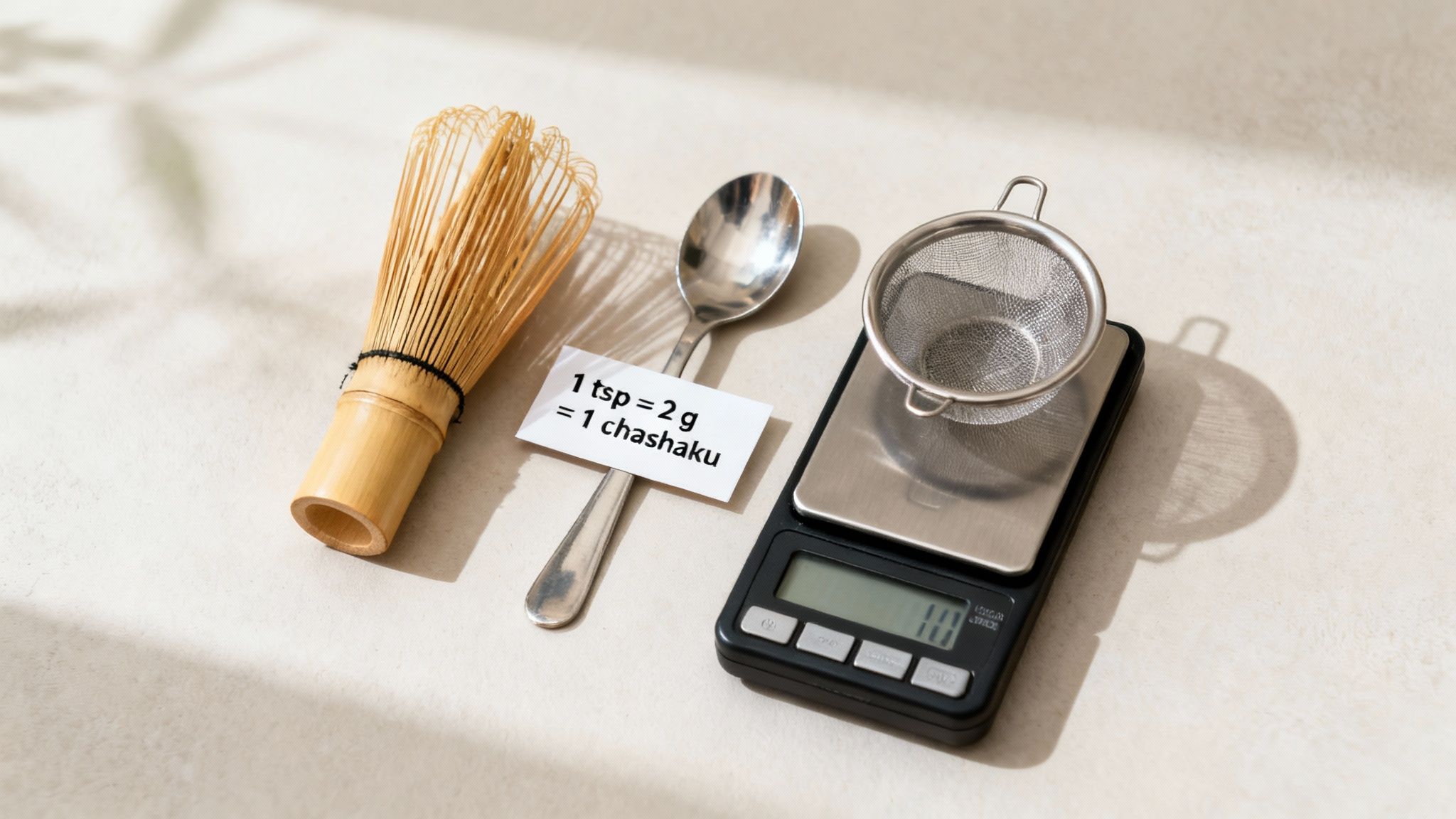
Knowing the right amount of matcha for your cup is one thing, but how you measure it is what truly guarantees a consistently beautiful brew. The secret to recreating that perfect cup, day in and day out, really comes down to precision. And your choice of tool plays a massive part in this.
You’ve got three main options in your tea-making arsenal. Each has its own charm and purpose, but they deliver vastly different levels of accuracy. Let's take a look.
The Tools of the Trade
When it comes to measuring your matcha powder, you’ll likely come across one of these:
- The Chashaku (Bamboo Scoop): This is the traditional Japanese tool, elegantly carved from a single piece of bamboo. It’s designed to scoop roughly 1 gram of matcha, but this can vary quite a bit depending on the scoop's size and how generously you heap it.
- The Teaspoon: A standard kitchen teaspoon is a handy alternative many of us have lying around. A level teaspoon typically holds about 2 grams of matcha powder. Again, though, the exact amount can change with the fineness of the powder and whether your spoon is actually level.
- The Digital Scale: For anyone serious about their matcha, this is the undisputed champion of precision. A good scale that measures down to 0.1 grams simply removes all the guesswork, ensuring flawless consistency every time.
While the chashaku adds a lovely, authentic feel to the ritual, it was never designed for pinpoint accuracy. A teaspoon is a perfectly fine starting point, but you might notice that small variations in your scooping lead to a surprisingly different flavour from one day to the next.
If you’re chasing that perfect brew, grams are the only truly reliable unit of measurement. Investing in a small digital scale is the single best thing you can do to elevate your daily matcha ritual from good to exceptional.
Why You Should Sift Before You Scoop
Here’s a crucial tip we always share with fellow matcha lovers: sift your powder before you measure it. This is especially important if you’re using volume-based tools like spoons or scoops.
Matcha is incredibly fine and has a tendency to clump together, thanks to static and any hint of humidity. These little clumps can trick you into thinking you have more powder than you really do, throwing your measurement off.
Sifting breaks them up, creating a light, airy powder that’s much more accurate to measure. As a bonus, it also makes whisking a breeze, helping you achieve that silky, froth-topped finish we all aim for.
Matcha Measurement Conversion Guide
To help you switch between tools or just get a feel for quantities, here’s a quick guide we've put together. Just remember, these are approximations—which is precisely why we always find ourselves coming back to a scale for the best results.
| Grams (g) | Teaspoons (tsp) | Bamboo Scoops (Chashaku) | Best For |
|---|---|---|---|
| 1-2 g | ½ - 1 tsp | 1-2 scoops | A traditional, thin Usucha tea |
| 3-4 g | 1 ½ - 2 tsp | 3-4 scoops | A rich, creamy matcha latte |
| 4-5 g | 2 - 2 ½ tsp | 4-5 scoops | A thick, ceremonial-style Koicha tea |
| 6+ g | 1 tbsp+ | 6+ scoops | Culinary uses like baking or smoothies |
This little chart should help you get your bearings, no matter which tool you have to hand.
If you're looking for an effortless way to get started, a dedicated 1-cup matcha portion spoon can be a brilliant addition to your kit, offering a much more reliable scoop every time. Ultimately, getting to know your tools is just as important as the matcha itself.
The Art of Preparing Your Measured Matcha
So, you’ve carefully measured and sifted your matcha. Now for the satisfying part: whisking it into a vibrant, frothy elixir. This is where a little bit of technique goes a long way. But before you even think about your whisk, the most crucial element to get right is your water temperature.
I can't tell you how many people I've seen use boiling water straight from the kettle. It’s the single fastest way to ruin a perfectly good bowl of matcha, turning it bitter and astringent. That searing heat essentially burns the delicate tea particles, killing all those complex, sweet notes and releasing harsh tannins. It’s a simple mistake, but one that’s probably turned countless people off what should be a delicious experience.
Finding The Water Temperature Sweet Spot
To truly protect the flavour and integrity of your high-quality matcha, you’re aiming for water that’s around 80°C (175°F). This is the magic number, the sweet spot that gently coaxes out all the umami, sweetness, and subtle vegetal notes without a hint of bitterness.
Don't have a fancy variable-temperature kettle? No problem. Getting it right is easier than you think.
- Just wait: Boil your kettle as normal, then just let it stand with the lid open for 2-3 minutes before you pour.
- The transfer trick: Pouring the boiling water into a separate mug or jug first will knock the temperature down almost instantly to where you need it to be.
This small tweak makes a massive difference. It's the secret to unlocking the true character of the matcha you’ve so carefully chosen.
The growing appreciation for quality preparation is clear. During one recent summer in the UK, matcha beverages were sold over 1.6 million times by more than 2,100 sellers in just two months. This shows a real shift towards valuing a well-made cup. You can discover more insights about Britain’s matcha moment on Squareup.
The Whisking Technique For Perfect Froth
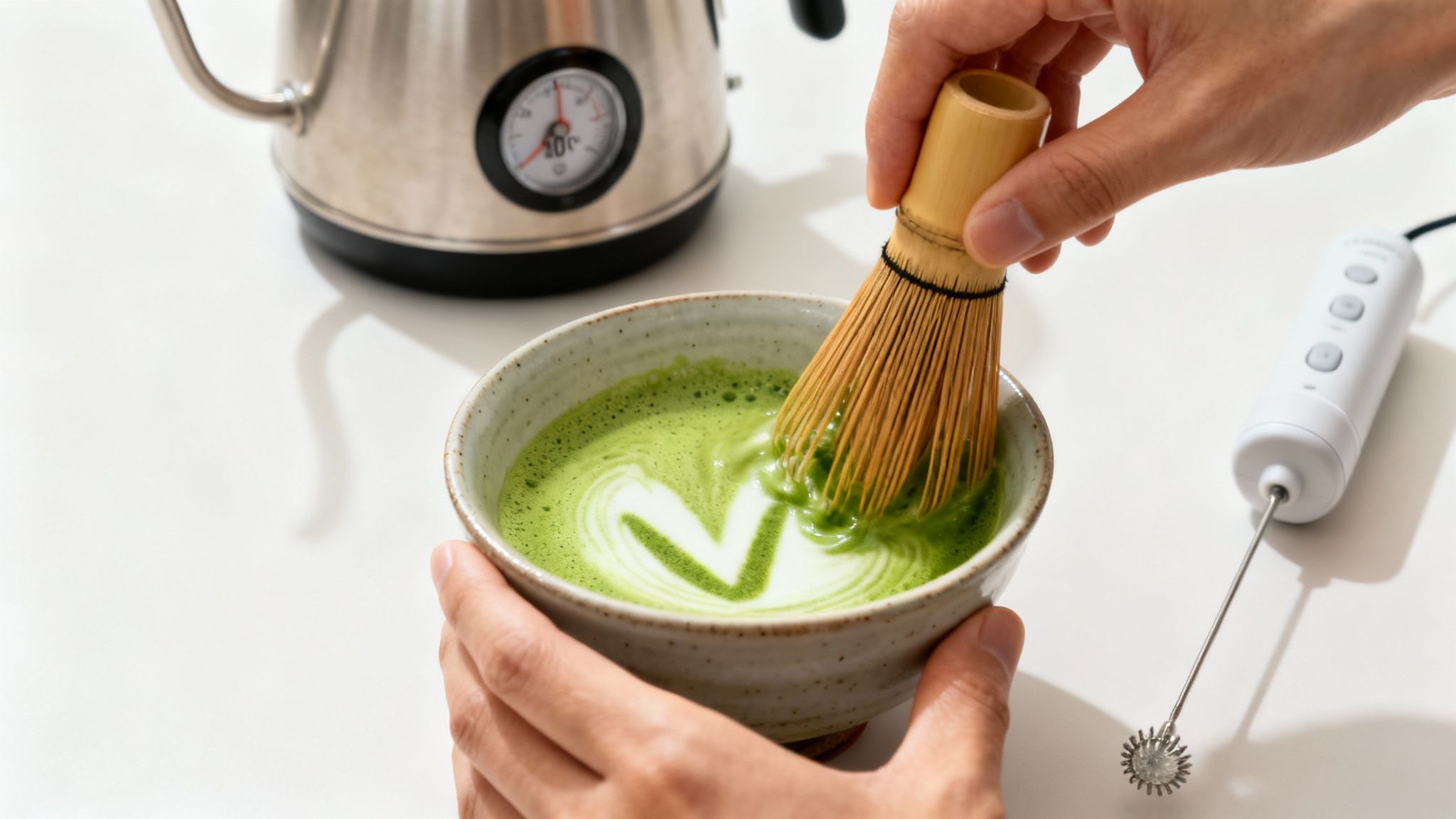
Now for the magic. Once you’ve added your hot water to the sifted matcha in your bowl (chawan), it’s time to get whisking. The goal here isn't just to mix it, but to create a uniform, lump-free suspension with a beautiful layer of fine foam on top.
The traditional bamboo whisk, or chasen, is designed perfectly for this job. You’ll want to forget stirring in circles – that just pushes the powder around. Instead, get a brisk zig-zag motion going. Imagine you're drawing a 'W' or 'M' shape back and forth, very quickly, making sure the tines of the whisk are just grazing the bottom of the bowl. Keep this up for about 20-30 seconds until you see a lovely, creamy froth starting to form.
No chasen? A small electric milk frother can do the trick. Just make sure you're using a deep enough bowl to avoid a green splash zone. Whatever tool you use, that rapid agitation is the key.
For a deeper look into the process, check out our complete guide on preparing matcha tea. Nailing this step is what ensures every single cup is as smooth and delicious as the last.
Common Matcha Measurement Mistakes and How to Fix Them
We’ve all been there. You follow the steps, but your matcha ends up lumpy, bitter, or just a bit… flat. Don't worry, it happens to the best of us. These little hiccups are incredibly common when you're starting out, and thankfully, they have simple fixes. Once you know what to look for, you’ll be on your way to a perfect, flavourful cup every single time.
The biggest culprit behind a bitter brew? Water that's far too hot. Pouring water straight from a boiling kettle is a surefire way to scorch the delicate matcha particles. Anything above 80°C will scald the tea, destroying its sweet, complex notes and bringing out harsh tannins instead. The easy fix is just to show a little patience—let your kettle sit for two or three minutes after it clicks off before you pour.
Overlooking the Sifting Step
Another classic mistake is skipping the sifting. Matcha powder is so incredibly fine that it loves to clump together, thanks to static and any hint of moisture in the air. If you just spoon it into your bowl and add water, you’ll be left with stubborn little nuggets of bitter, undissolved powder. No amount of whisking can fully break them down.
This leads to a gritty texture and a really uneven taste. The solution is simple: always pass your matcha through a small, fine-meshed sieve before adding water. It’s a tiny step that makes a massive difference, guaranteeing that silky-smooth consistency we’re all after.
Our Pro Tip: Keep a dedicated small sieve right next to your matcha tin. When it becomes part of your ritual, you won’t even think about it, but you’ll definitely taste the difference.
It’s no surprise people are keen to get it right. The UK's love for a proper brew has fully extended to matcha, with sales seeing a staggering 202 percent increase in just one year as it shifted from a niche health food to a mainstream favourite. You can learn more about the UK's matcha obsession to see just how popular this daily ritual has become.
Using Old Matcha or Improper Whisking
Finally, there are two other things that can let down your matcha-making efforts: stale powder and a lazy whisking technique. Matcha is a fresh product and its vibrant character fades over time, especially when it’s exposed to air and light. Old matcha will taste dull and look less bright. Always store your tea in an airtight container in a cool, dark spot.
The other piece of the puzzle is your whisking motion. Simply stirring your matcha in circles won’t create that beautiful, stable froth. You need a brisk, zig-zag motion, like you’re writing the letter 'W' over and over again. This aerates the tea and suspends the particles evenly, giving you a smooth, integrated and utterly delicious drink.
A Few Final Matcha Questions
Even when you have all the right kit and a solid technique, a few questions always seem to pop up. Getting your matcha-to-water ratio spot on can feel more like an art than a science at first, but a few quick answers can clear up any confusion. Let’s tackle some of the most common queries we get.
Can I Just Add More Matcha For A Stronger Flavour?
It seems logical, doesn't it? If you want a bolder taste, just add more powder. But this is a classic misstep that can easily backfire, especially when you're working with high-quality ceremonial matcha. Doubling your usual 2-gram scoop won't give you a richer flavour – it'll probably just give you a harsh, overpowering bitterness. Ceremonial grade is a delicate thing, and its balance is everything.
If you are craving a more intense experience, you’re better off trying a traditional Koicha (thick tea). This uses roughly 4 grams of matcha to just 30-40 ml of water, creating a syrupy, potent brew that really showcases the deep umami notes without veering into bitterness. For lattes made with culinary matcha, you have a bit more wiggle room to add an extra gram or so for a stronger kick.
How Should I Adjust The Ratio For An Iced Matcha Latte?
Making an iced matcha latte changes the game a bit. The cold temperature can dull flavours, and when you add ice and a larger volume of milk, your standard ratio will end up tasting weak and watery. You’ll definitely need to up the amount of matcha to compensate.
For a standard 350 ml (12 oz) glass, a good starting point for an iced latte is 4 grams (about two level teaspoons) of culinary grade matcha. This ensures the earthy, distinct flavour of the matcha can punch through the cold milk and ice, giving you a balanced, refreshing drink rather than a vaguely green, milky one.
Our Tip: Always make a concentrated matcha shot first. Whisk the powder with a small amount of hot (never boiling!) water before adding it to your cold milk and ice. This makes sure it dissolves completely, so you won’t get any gritty clumps in your finished drink.
Does More Matcha Mean More Caffeine?
Yes, it’s a direct relationship. The more matcha powder you use, the higher the caffeine content in your cup. A standard 2-gram serving of matcha typically has around 60-70 mg of caffeine.
If you double that to 4 grams for a punchy latte or a Koicha, you're also doubling your caffeine intake to 120-140 mg. That puts it right on par with a strong cup of coffee, so it’s a simple way to tailor your morning energy boost.
How Much Matcha Is Too Much In A Day?
While matcha is packed with good things, it’s always wise to enjoy it in moderation. Most experts suggest that up to eight grams of matcha per day is generally fine for most adults, which works out to about four standard 2-gram servings.
Pushing much beyond this could lead to too much caffeine, which might cause jitters, an upset stomach, or disrupt your sleep. The most important thing is to listen to your body; find the amount that leaves you feeling focused and calm, not wired.
Ready to perfect your daily ritual with the finest, ethically sourced tea? Jeeves & Jericho offers premium ceremonial and culinary matcha, sourced directly from the renowned artisans of Uji, Japan. Explore our matcha collection and find your perfect brew today.