


Right, let's get straight to the heart of the matter. If you remember just one thing, make it this: the classic starting point is one rounded teaspoon of loose leaf tea for every 240ml (that's about 8 ounces) of water. This simple measure, which works out to about 2-3 grams, is your ticket to a consistently balanced and flavourful brew.
Finding Your Perfect Tea Measurement
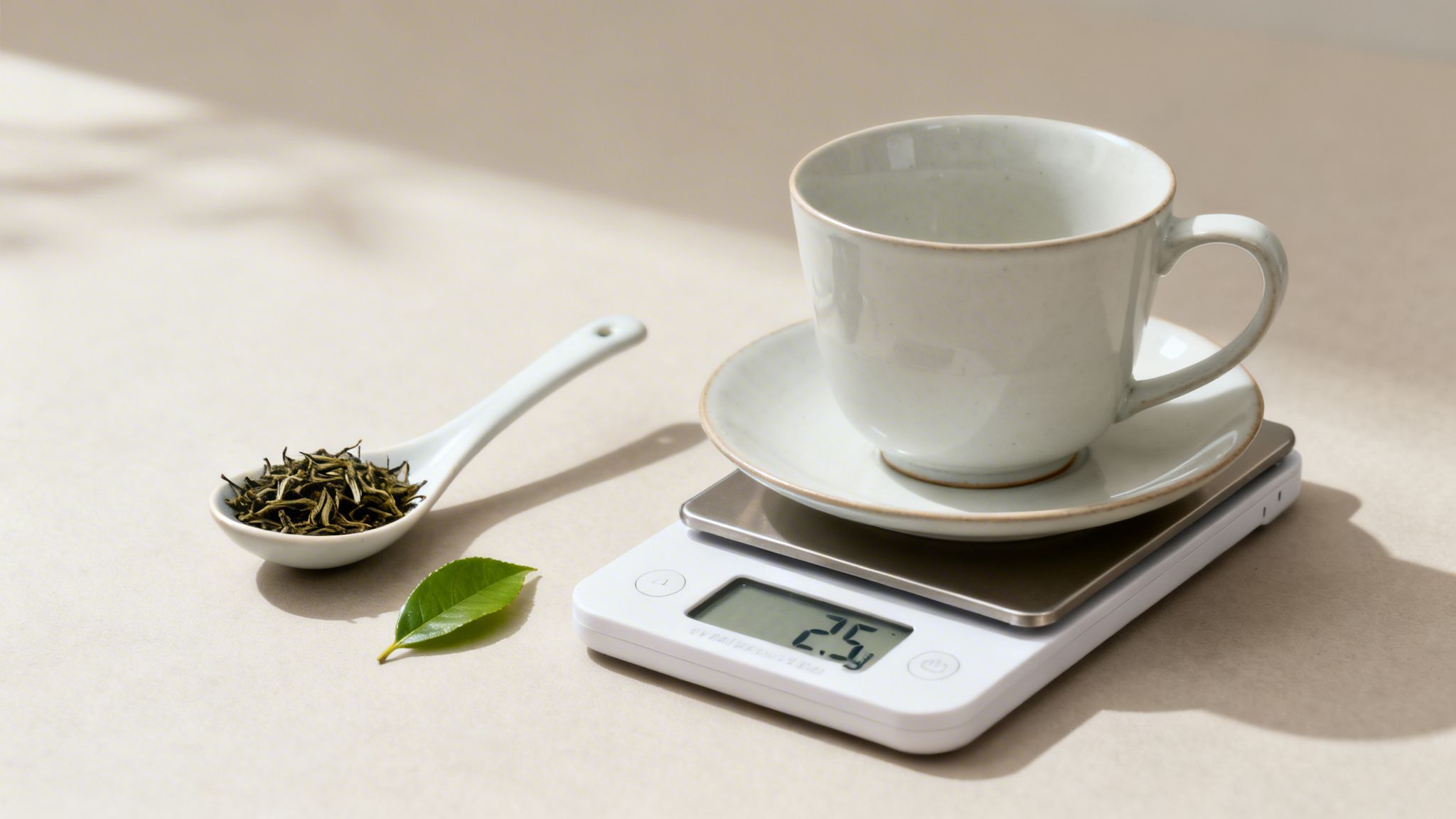
Think of this guideline as the foundation for taking your tea from simply 'good' to genuinely brilliant. It’s the secret to unlocking the full aromatic potential of beautiful whole-leaf teas, like those we source here at Jeeves & Jericho, without accidentally making a brew that's too strong or too weak.
This isn't just our opinion; it's a standard that's long been championed here in Britain. The UK Tea & Infusions Association (UKTIA) stands by the one-rounded-teaspoon rule to ensure you get the best flavour from the leaves without tipping into bitterness. It’s all about creating a reliable, repeatable cup, every single time.
The real magic of a remarkable cup of tea isn't just in the quality of the leaves, but in the care of your preparation. Mastering the right tea-to-water ratio is the first, most important step to becoming your own tea expert.
This idea of precise measurement is a common thread in creating great drinks, from getting your loose leaf tea just right to optimizing beverage strength for the perfect espresso shot. While a teaspoon is a brilliant and easy tool, we'll get into why a small digital scale can take your brewing to another level a bit later.
For now, here’s a quick guide to get you started on your next brew.
Quick Guide to Loose Leaf Tea Per Cup
This handy table summarises the standard measurements for brewing a perfect cup.
| Measurement Type | Standard Amount | Notes |
|---|---|---|
| By Volume | 1 rounded teaspoon | Perfect for beginners and quick, everyday brews. |
| By Weight | 2-3 grams | This is the most accurate method for consistent results. |
| For Mugs | 1.5 teaspoons | A good rule of thumb for mugs larger than 240ml. |
Keep this table in mind as your starting point, and you'll be well on your way.
Why Weight Beats Volume for a Consistent Brew
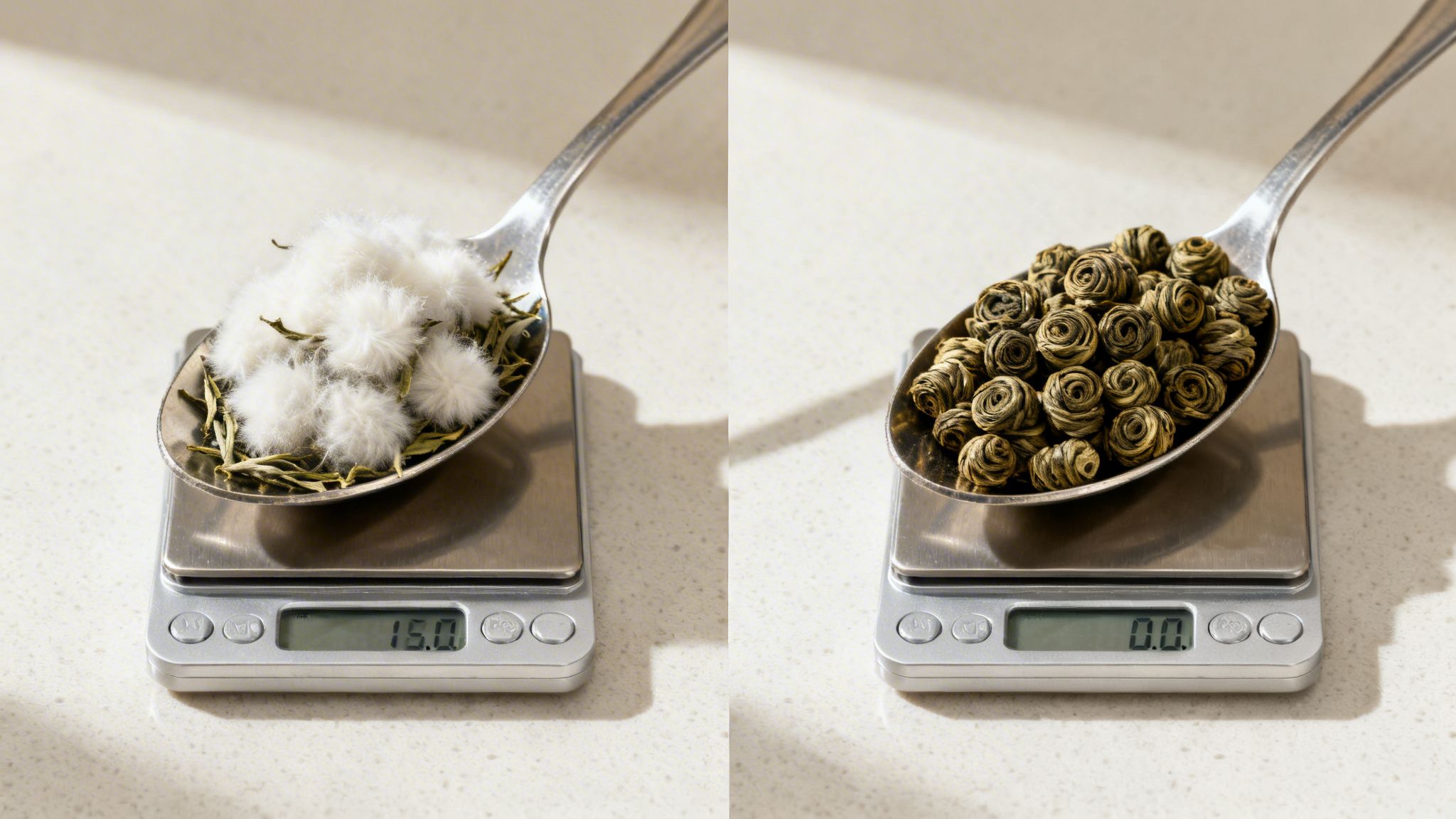
Ever wonder why your cuppa tastes amazing one day and a bit 'off' the next, even when you've used the same spoon? The secret isn't in your brewing technique; it's all down to one simple thing: density.
Think of it this way. Picture one teaspoon piled high with fluffy, light-as-air white tea. Now, imagine that same spoon holding a scoop of dense, tightly rolled oolong pellets. You’ve got the same volume—one teaspoon—but the actual amount of tea in each is completely different. The rolled oolong is much, much heavier.
This is precisely why tea professionals and serious enthusiasts always measure in grams. A digital scale doesn't care if the leaves are big and feathery or small and rolled. It measures pure mass, meaning you get the exact same amount of tea for your pot, every single time.
The Problem with Teaspoons
Look, your trusty teaspoon is a brilliant tool for a quick, everyday brew. We use them all the time. But it’s worth understanding its limits if you're chasing that perfectly consistent cup, especially when you start exploring the incredible variety of loose leaf teas out there.
Just think about the different teas you might have in your cupboard. A single teaspoon could hold:
- As little as 1 gram of a light, bulky white tea like a Silver Needle.
- Around 3 grams of a classic black tea, such as an English Breakfast.
- Up to 5 grams of a dense, rolled gunpowder green tea.
If you used that same spoon for all three, you'd get wildly different results—from a brew that’s disappointingly weak to one that’s overwhelmingly strong.
By measuring how much loose tea per cup by weight, you take all the guesswork out of it. You can perfectly recreate that amazing cuppa you made last Tuesday, ensuring every brew is just as good as the last.
Once you grasp this, brewing becomes less of a game of chance and more of a reliable craft. You can absolutely carry on using your favourite spoon, but knowing why a scale offers more precision will elevate your tea-making no end. For those who want to dive deeper, our complete guide to loose leaf tea is packed with even more insights.
Matching Your Scoop to Your Tea Type
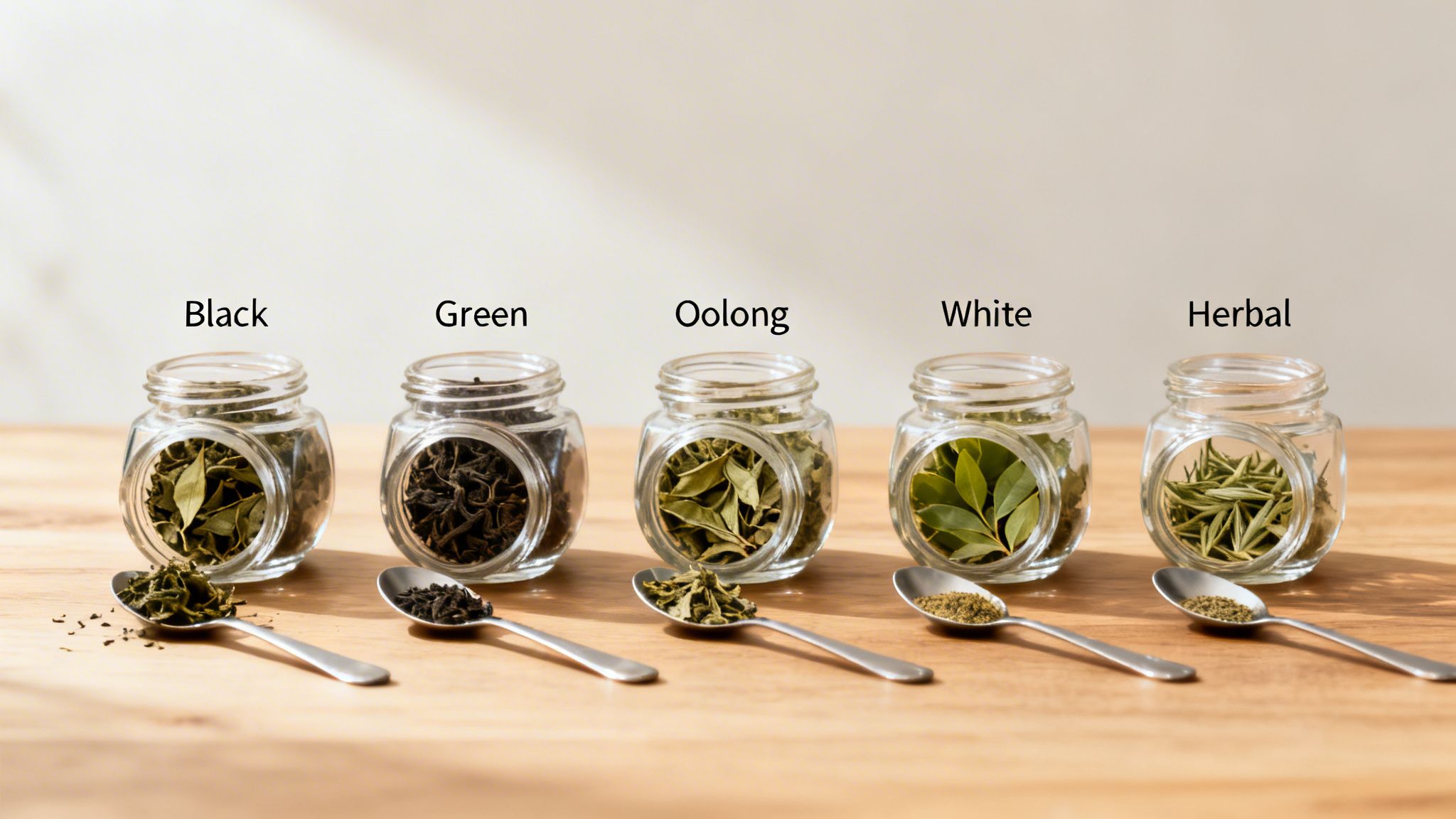
As anyone who’s explored loose-leaf tea knows, not all leaves are created equal. This is where a one-size-fits-all scoop just doesn't cut it. The shape, size, and density of the leaves mean a teaspoon of one tea can be wildly different from a teaspoon of another.
Take a fluffy, delicate white tea. You might need a generously heaped teaspoon to hit that sweet spot of 2-3 grams. But for a dense, tightly rolled gunpowder green, a level teaspoon is often more than enough. You're getting much more tea packed into a smaller space. Understanding this relationship is the real secret to a perfect brew.
It’s a detail more and more people are appreciating. During the 2020 lockdowns, a survey of 2,000 Brits revealed that 24% started drinking more loose-leaf tea. Why? Better taste (34%) and sustainability (25%) were the top reasons – a welcome shift, especially when you consider the 61 billion teabags we throw away each year. You can read more in the full survey findings.
Recommendations for Different Teas
So, to take the guesswork out of it, here are some reliable starting points for different types of tea. We're basing these on a standard 240ml (or 8oz) cup.
-
Black Teas: For classics like English Breakfast or our Spiced Bombay Chai, a single rounded teaspoon (about 2.5 grams) is perfect. The leaves are usually cut to a fairly uniform size, so they’re a doddle to measure.
-
Green Teas: These can be a bit more sensitive. To avoid any bitterness with wiry or rolled leaves like Sencha or Gunpowder, a level teaspoon (around 2 grams) is your best bet. If you're brewing a larger, flat-leaf green, you can be a bit more generous with your scoop.
-
White & Oolong Teas: These two are notoriously tricky. Fluffy white teas such as Silver Needle are so light they often need two teaspoons (about 2 grams) to get enough flavour into the cup. On the other hand, dense, rolled oolongs can pack a punch, so one level teaspoon (which can be up to 3 grams) is all you need.
At the end of the day, it's all about getting the right weight of tea into your pot. A dedicated 1-cup portion spoon is a brilliant little tool that helps you get it right every time, without faffing about with scales for every single brew. Simple and precise.
Adjusting for Your Mug and Personal Taste
The measurements we’ve covered are a great place to start, but let's be honest – the best cup of tea is the one you love. Your favourite mug might be a behemoth compared to the standard 240ml cup, and your own preference for a bold brew versus a delicate one is what really counts. This is where you graduate from following instructions to becoming a true tea artist.
Think of the standard rule as your baseline. If you fancy a stronger, more robust flavour, try nudging the amount up a bit—maybe an extra quarter of a teaspoon. On the other hand, if you find your brew a little too punchy, simply dial it back. You'll be amazed at how these tiny adjustments can fine-tune the strength, keeping your tea out of that dreaded bitter or watery territory.
Scaling Up for Mugs and Teapots
When brewing for a bigger vessel, the logic is wonderfully simple. For an oversized mug, you might go for one and a half rounded teaspoons instead of just the one. And for a teapot, that time-honoured British advice still rings true: "one for each cup, and one for the pot." That little extra scoop for the pot is the secret to ensuring the final brew has a proper, full-bodied flavour and doesn't taste diluted.
This focus on getting the amount right is a cornerstone of British tea culture. The UK Tea & Infusions Association’s advice of one rounded teaspoon per cup is partly a reaction to our hurried brewing habits. Their 2022 Tea Census found that a staggering 73% of people steep black tea for less than the recommended 3-4 minutes, which makes getting that initial measurement spot on even more vital. You can dive deeper into British tea habits from the full study.
Don't be afraid to experiment. Your taste buds are your best guide. Brewing the perfect cup is a personal journey of discovery, and finding what you love is the most rewarding part.
At the end of the day, things like water quality and temperature play a huge part in the final taste, too. If you’ve tinkered with the tea amount and your brew still isn't quite hitting the mark, it might be worth exploring the best water temperature for tea to perfect your technique.
Common Measuring Mistakes You Can Easily Avoid
That disappointing cup of tea—the one that’s either weak and watery or harsh and bitter—often comes down to a simple measuring mistake. The good news? These common pitfalls are incredibly easy to fix. A few small tweaks to your technique will make sure the high-quality Jeeves & Jericho teas you love always taste their absolute best.
One of the most frequent slip-ups is grabbing any old teaspoon from the cutlery drawer. These kitchen spoons vary wildly in size, which is a recipe for an inconsistent brew every single time. A proper measuring spoon is a must for repeatability.
Another classic error is packing the leaves down. When you squash fluffy tea leaves into your spoon, you're cramming in far more tea by weight than you realise. This almost always leads to an over-extracted, bitter cup, especially with delicate green or white teas. You’re aiming for a light, airy scoop.
Why Your Scoop Size Matters
It’s also crucial to adjust your scoop for the type of leaf you're using. Many people go wrong by not accounting for the size and density of the leaves. An unusually large or fine tea needs a different approach.
Here are a couple of scenarios to keep in mind:
- For large, bulky leaves: Picture a delicate white tea with big, fluffy leaves. You’ll probably need a heaping scoop just to get enough flavour into your cup.
- For fine, dense leaves: Small, tightly rolled teas like gunpowder green are much heavier than they look. Your usual rounded teaspoon will give you a brew that’s far too punchy. A level spoon is a much safer bet.
The secret to a great cup isn’t just knowing how much loose tea per cup to use, but understanding how to measure it properly. Steer clear of these simple mistakes, and you’ll notice a world of difference in your daily brew.
By being mindful of your spoon, not packing the leaves, and adjusting for leaf size, you’re swapping guesswork for intentional brewing. Think of it as your guide to brewing with confidence, ensuring every single cup is a delight.
Your Tea Brewing Questions, Answered
Once you've got the basics down, a few little questions always seem to bubble up. You're not alone! Here are some of the most common queries we hear from fellow tea lovers, designed to help you go from a good brewer to a truly intuitive one.
Let's get into the practical details that will really finesse your tea-making skills.
Can I Reuse Loose Leaf Tea?
Yes, absolutely! In fact, one of the greatest joys of using high-quality, whole-leaf tea is that you should be re-steeping it. Many teas, particularly oolongs and certain green teas, have fascinating new layers of flavour and aroma just waiting to be discovered in a second or even third infusion.
For each new steep, just nudge the water temperature up a little or extend the brewing time slightly to draw out the remaining goodness. Don't be surprised if your second cup is just as delicious—or perhaps even more complex and nuanced—than the first. It's a brilliant way to get more flavour and value from your favourite leaves.
Many tea connoisseurs believe the second steep reveals the true "soul" of the tea. It's the moment the leaves have fully unfurled and release their most intricate character.
How Much Loose Tea for Iced Tea?
When you're making a refreshing pitcher of iced tea, you need to start with a much stronger brew. Why? Because it needs to hold its own against all that melting ice which will dilute it.
A good rule of thumb is to simply double the amount of tea you'd normally use. So, if your usual is one teaspoon per cup, make it two.
For a standard one-litre jug, we'd suggest starting with 8-10 teaspoons (or about 16-20 grams). Brew it strong using half the usual amount of hot water, then pour the hot, concentrated tea directly over a jug packed with ice.
Does Water Temperature Affect How Much Tea I Use?
This is a great question. While water temperature is absolutely vital for extracting the right flavours, it doesn't really change the quantity of tea leaves you need. That trusty starting point of 2-3 grams per 240ml cup holds firm, whether you’re brewing a delicate green tea at a gentle 80°C or a punchy black tea at 95°C.
The one big exception? Cold brewing. When you're infusing tea in cold water over many hours, you'll want to be more generous. We recommend using 1.5 to 2 times the normal amount to ensure you get a rich, full-bodied flavour from the long, slow steep in the fridge.
Ready to put your newfound brewing confidence to the test? Explore the exceptional collection of whole-leaf teas at Jeeves & Jericho and discover the difference that quality and precision can make. You can find your next favourite brew at www.jeevesandjericho.com.