


Making the perfect matcha iced tea is surprisingly straightforward. At its heart, it's just a matter of sifting matcha powder into a bowl, whisking it with a little cool water to form a paste, then topping it all off with more cold water and ice. That’s the essence of it, but mastering the technique turns a simple drink into a sublime one.
Your Guide to Vibrant Homemade Matcha Iced Tea
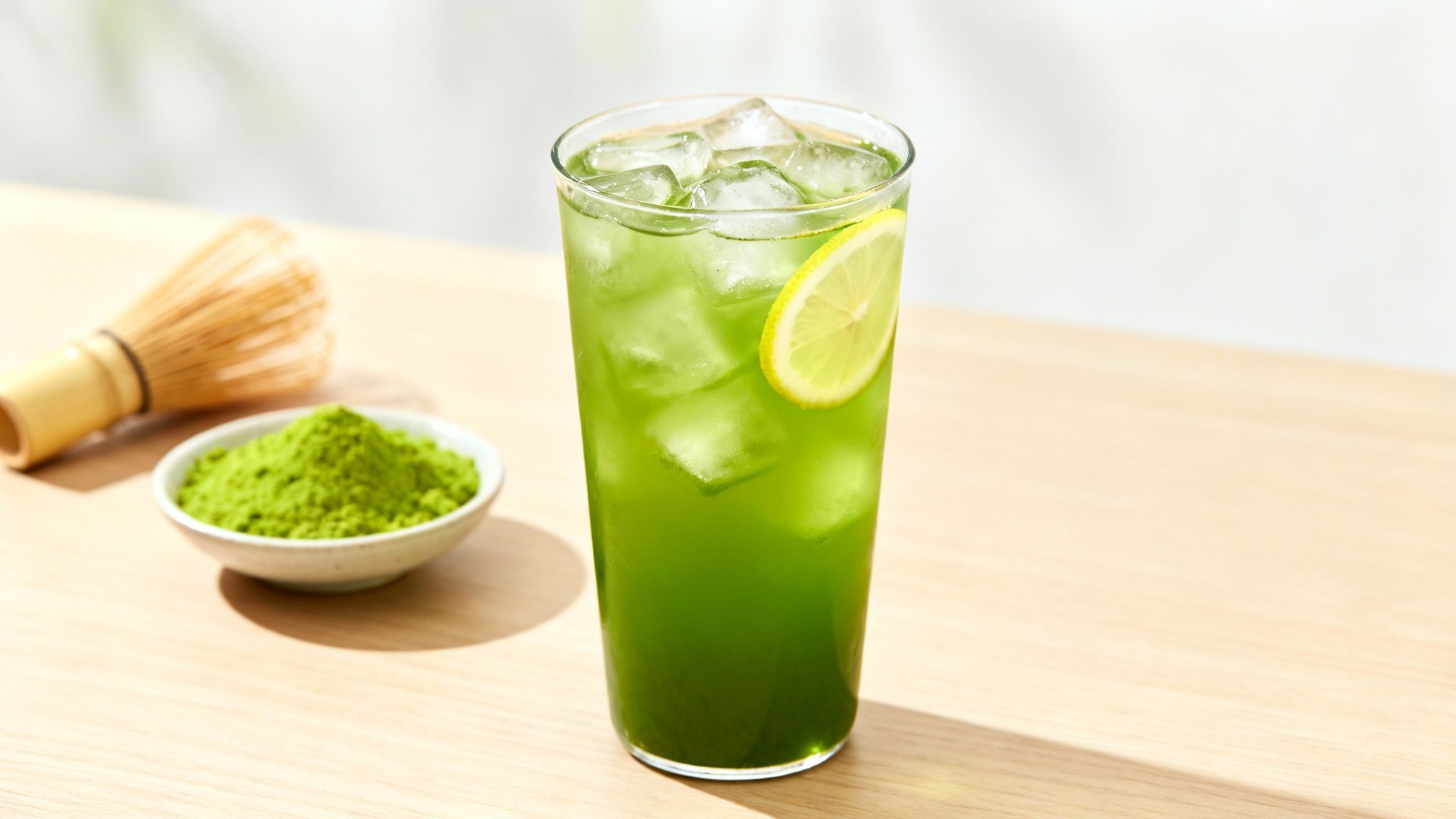
If you're after a delicious and healthful alternative to your usual cold drink, you've landed in the right spot. This guide is designed to demystify the process of making café-quality matcha iced tea right in your own kitchen, taking you beyond a simple stir-and-sip.
Matcha has seen a huge surge in popularity, and for good reason. It offers a unique, earthy flavour and a gentle, focused energy boost that’s perfect for an afternoon pick-me-up. The numbers back this up, with the UK Matcha Tea Market projected to grow from around USD 340 million in 2025 to nearly USD 790 million by 2031. This reflects a real shift towards more mindful, functional drinks. For a deeper dive into these trends, check out the market data from Mobility Foresights.
Let’s lay a strong foundation for your brewing journey.
Understanding the Basics
Before we jump into the recipes, it's worth understanding what makes a great iced matcha. Unlike regular tea, with matcha, you’re consuming the entire leaf ground into a fine powder. This makes two things absolutely critical:
- Matcha Quality: The grade of your matcha powder has the biggest impact on flavour. For iced tea, I always recommend a ceremonial grade. It has a much smoother, less bitter profile than culinary grade, which is better suited for baking.
- Preparation Method: How you mix the matcha is everything. A lumpy, poorly mixed drink is just disappointing. Nailing your technique is the key to getting that silky-smooth texture every single time.
The secret to a perfect matcha iced tea isn't complexity; it's technique. A smooth, clump-free consistency is the goal, and it’s achievable with just a few simple steps, regardless of the tools you have.
Choosing Your Method
We're going to cover three brilliant methods for making matcha iced tea at home, each suited to different situations. Whether you have two minutes or a couple of hours, there’s a technique here for you.
Matcha Iced Tea Methods At a Glance
To help you decide where to start, here’s a quick comparison of the three methods we'll be exploring.
| Method | Time Required | Equipment Needed | Best For |
|---|---|---|---|
| Traditional Whisked | 5 Minutes | Bowl & Bamboo Whisk | Achieving a perfect, frothy texture at home |
| Quick Shaken | 2 Minutes | Jar or Shaker | A fast, convenient option for on-the-go |
| Effortless Cold Brew | 2 Minutes Prep + 2 Hours Chill | Jar or Bottle | The smoothest, most mellow flavour with zero bitterness |
Each approach has its own charm. The traditional whisked method is a mindful ritual that produces beautiful results, the shaken method is for when you're in a rush, and the cold brew is for those who plan ahead for the ultimate smooth finish. Let's get into the details of each one.
Choosing Your Matcha and Essential Tools
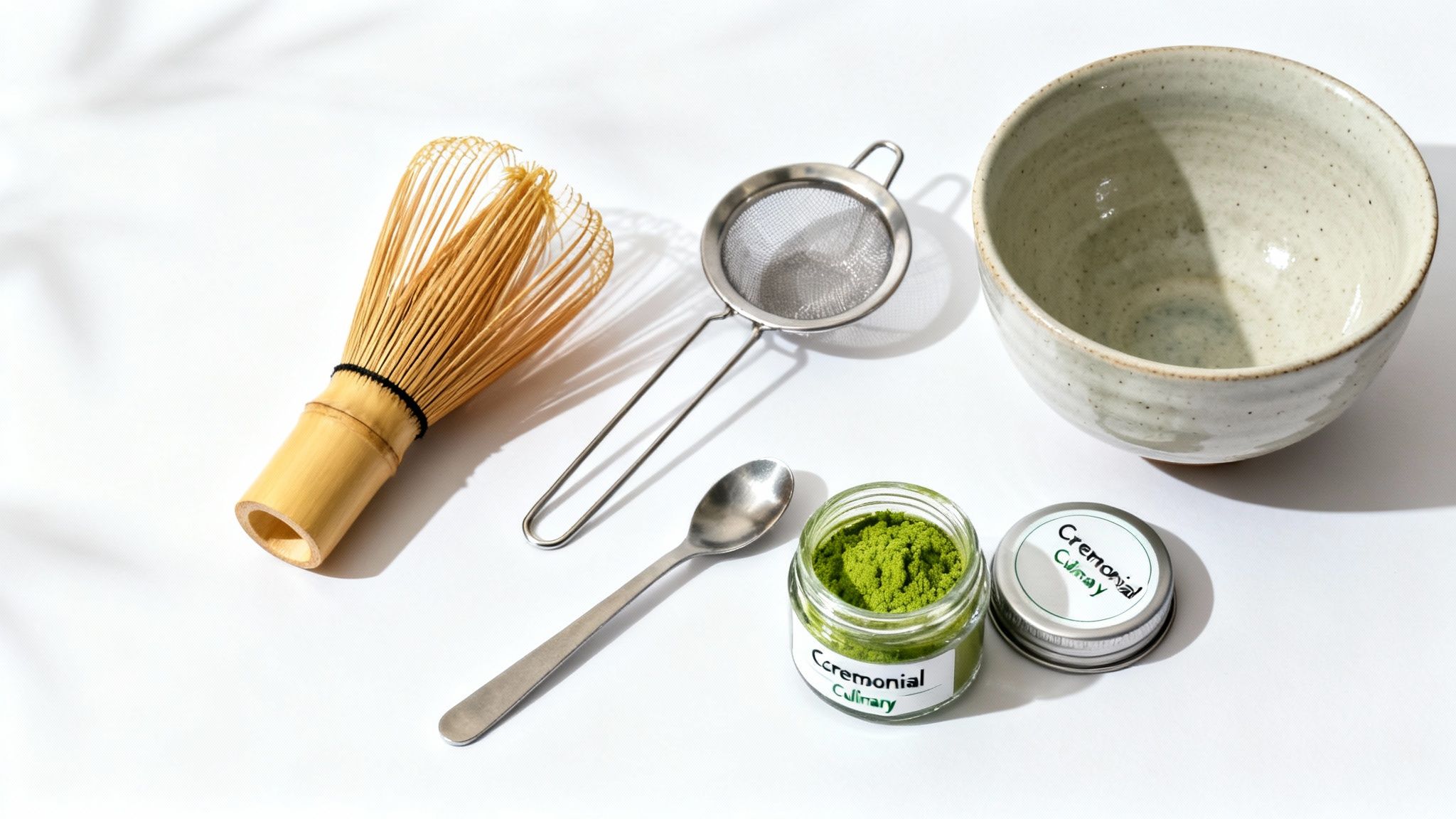
Before we get to the recipes, let's talk about the two things that will make or break your matcha iced tea: the powder itself and a few simple tools. You don’t need to invest in a full Japanese tea ceremony kit, but a couple of items will make getting that perfectly smooth, vibrant green drink a lot easier.
The main challenge is getting a completely clump-free liquid. A traditional bamboo whisk, called a chasen, is the classic tool for the job. Its 80-plus tiny prongs are brilliant for aerating the tea and dissolving the powder into a smooth paste.
But you have other options. A small metal whisk works well, and a modern electric milk frother is fantastic for quickly whipping up the matcha concentrate. If you have neither, no problem at all. My favourite shortcut, which we'll cover in the "Quick Shaken Method," just requires a clean jar with a tight-fitting lid. It’s surprisingly effective when you're in a rush.
Selecting Your Matcha Powder
This is easily the most important choice you'll make. The quality of your matcha powder dictates everything—the flavour, the colour, and the entire experience. You'll generally come across two main grades: ceremonial and culinary.
-
Ceremonial Grade: This is the best of the best, made from the youngest, most tender tea leaves. It has a stunning, vibrant green colour and a delicate, almost sweet flavour with very little bitterness. It’s designed to be whisked with water and sipped pure, making it the perfect choice for iced tea where its subtle character can really stand out.
-
Culinary Grade: Made from older leaves, this grade has a stronger, more assertive, and often more bitter flavour. It's fantastic for baking or blending into lattes and smoothies, where sugars and fats can balance its intensity. For a simple iced tea, however, it can taste a bit harsh.
For a truly exceptional matcha iced tea, always go for ceremonial grade. The difference is night and day—you’ll get a much smoother, sweeter, and more vibrant drink without any of the bitterness that can spoil it.
When you're choosing a brand, look for matcha from famous Japanese regions like Uji or Nishio. Good matcha should have a brilliant, vivid green colour. If it looks dull, yellowish, or brownish, it’s a sign of lower quality or old stock. To learn more, our guide on the different types of matcha tea is a great place to start.
Finally, a quick word on storage. Once you open your matcha, keep it in an airtight container in the fridge. This protects its delicate flavour and bright colour from light, heat, and air.
Three Proven Methods for Perfect Iced Matcha
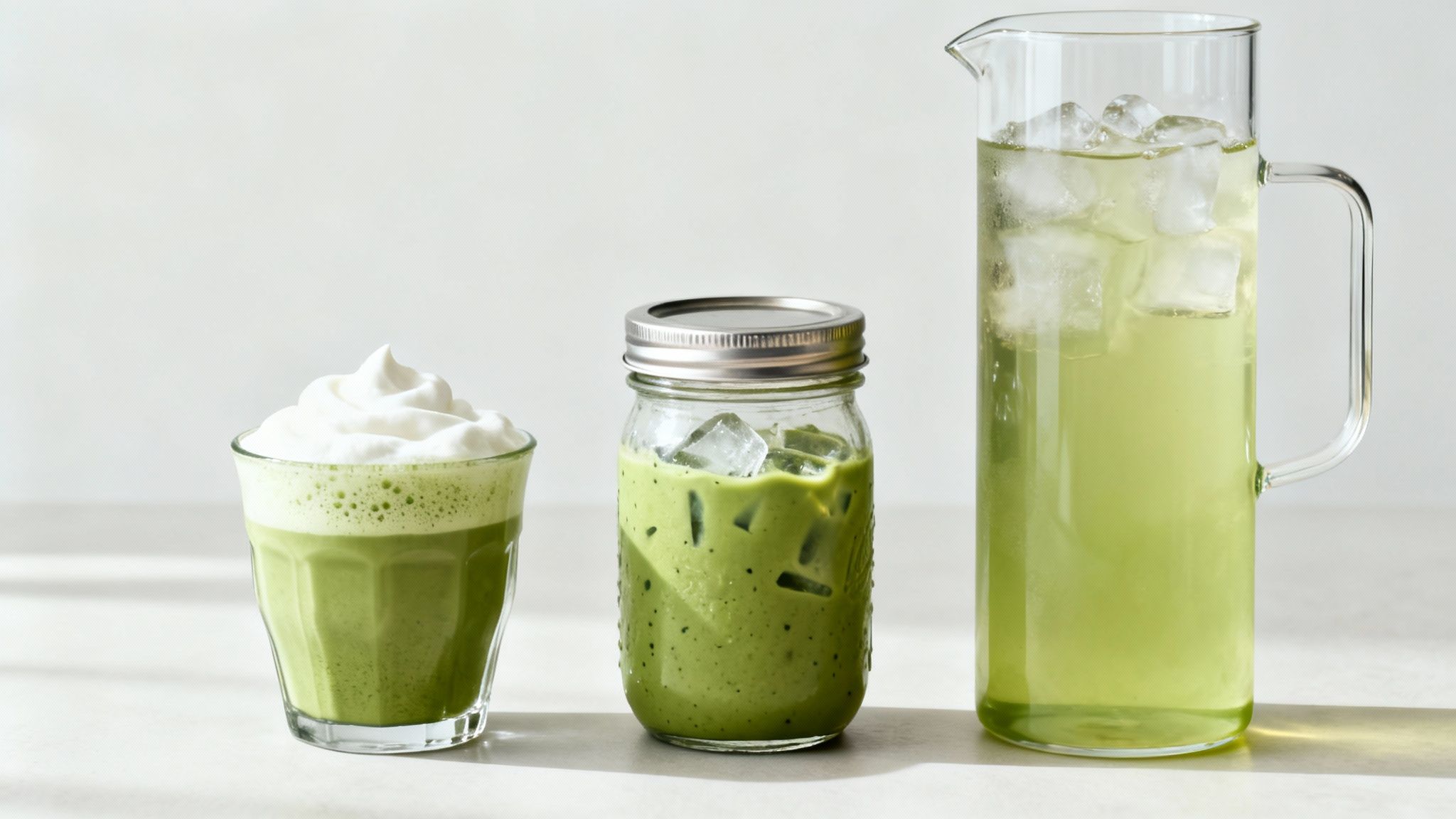
Alright, you've picked out your matcha and gathered your tools. Now for the fun part: actually making it. There’s no single "right" way to whip up an iced matcha. The best approach really comes down to your schedule, what kit you have on hand, and the kind of texture you're after. Let's walk through three brilliant techniques, each one delivering a beautifully refreshing result.
The boom in people making matcha at home is hardly a surprise. If you look at recent import data, you’ll see that matcha tea imports in the UK shot up by roughly 31.95% in a single year. It's clear that more and more of us are discovering the joy of creating our own matcha drinks. You can get more of the story on the surging demand for matcha on 6wresearch.com.
We'll kick things off with the most authentic method.
The Traditional Whisked Method
Think of this as a mindful ritual that produces a truly superior, frothy texture. It's the perfect technique for a quiet afternoon when you can spare a few minutes. Using a traditional bamboo whisk, or chasen, is essential here. Its delicate tines are perfectly designed to suspend the powder in the water and create that signature delicate foam.
First, sift 1 teaspoon (around 2 grams) of ceremonial grade matcha into a wide bowl. I can't stress this enough—sifting is non-negotiable if you want a lump-free drink. Next, pour in about 60 ml (2 oz) of cool or room-temperature water.
Now for the whisking. You'll want to move your whisk vigorously in a 'W' or 'M' shape, not in circles. This quick, jagged motion is what introduces air and builds a smooth, frothy paste—the very heart of your drink. Once it looks uniform and foamy, pour it into a tall glass filled with ice. Top it up with another 180 ml (6 oz) of cold water and give it a gentle stir to combine.
The Quick Shaken Method
When you're rushing out the door or simply away from your kitchen, this shaken method is an absolute lifesaver. It’s my personal go-to on busy mornings because it needs next to no equipment – just a jar with a tight-fitting lid or even a cocktail shaker will do. The result is a brilliantly mixed and perfectly chilled tea in less than a minute.
Here’s the drill:
- Add 1 teaspoon of matcha straight into your shaker or jar. Sifting isn't as crucial here, but it still helps if you’ve got the time.
- Pour in 240 ml (8 oz) of cold water.
- Toss in your sweetener, if using, and a few ice cubes to help with the mixing.
- Seal the lid tightly and shake it like you mean it for about 30 seconds. You’re aiming for the powder to be completely dissolved with a nice layer of foam on top.
Simply pour the entire mixture, ice and all, into your glass. It's an incredibly efficient technique that gives you a consistently smooth result every time, no special tools required.
The Effortless Cold Brew Method
If smoothness is what you're after, the cold brew method is your answer. It does require a bit of forward planning, but the hands-on time is practically zero. This technique coaxes the flavour out of the matcha slowly, yielding an incredibly mellow, sweet tea with absolutely no bitterness. It’s the ultimate set-and-forget option.
To make cold brew matcha, just combine 1 to 1.5 teaspoons of matcha powder with 500 ml of cold, filtered water in a bottle or jar. Shake it vigorously for a minute or so until the powder is mostly mixed in. Don't worry if it doesn't look perfectly smooth just yet.
Pop the sealed container in the fridge for at least two hours, or even better, overnight. This slow infusion gives the matcha time to fully dissolve and lets its flavour profile develop beautifully, creating the smoothest iced tea imaginable.
Before you serve it, give the bottle one last good shake to wake everything up and pour over a glass of ice. This approach is also fantastic for making bigger batches to have on hand. If you find you enjoy this technique, you might like our guide on how to make cold brew tea with traditional tea leaves too.
How to Craft the Perfect Iced Matcha Latte
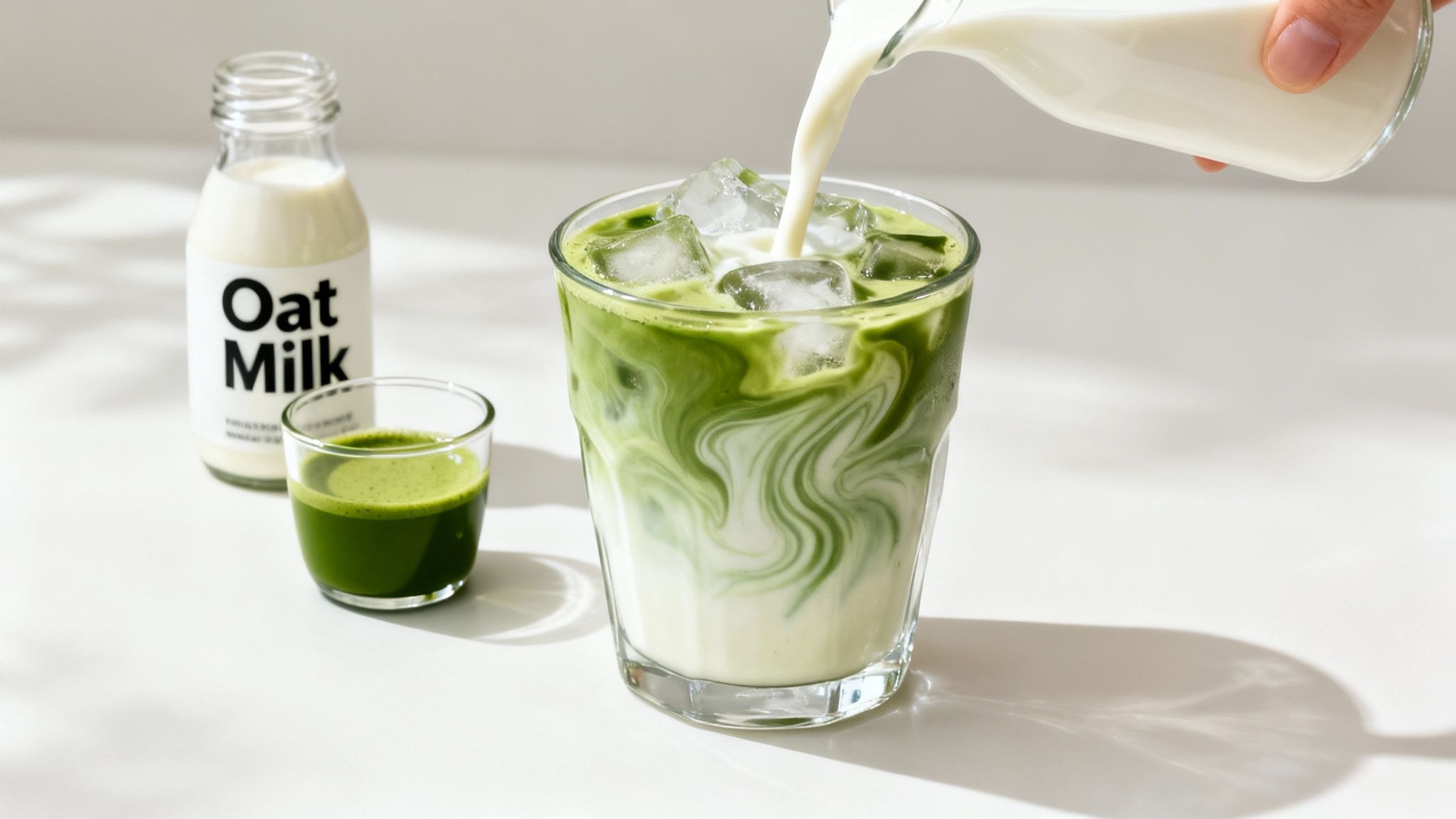
If you're after something a bit more decadent, the iced matcha latte is a real treat. It’s richer and creamier than a simple matcha tea, offering a wonderfully luscious texture that balances the vibrant, grassy flavour of the matcha. With a few simple tricks, you can whip up a latte at home that’s every bit as good—if not better—than your local café’s.
The secret to a truly great iced matcha latte is all in the prep. You need to create a concentrated matcha 'shot' first. This little step is what separates a smooth, silky latte from a gritty, clumpy disappointment. Just whisk or shake 1 teaspoon of ceremonial grade matcha with about 60 ml (2 oz) of cool water until it’s perfectly smooth and has a nice bit of froth on top. This potent shot will then blend beautifully into your milk.
Choosing Your Milk and Sweetener
With your matcha shot ready, the next step is choosing the milk. This is where you can really start to personalise your drink, as the milk you pick has a huge say in the final flavour and texture.
- Whole Dairy Milk: The classic choice. It delivers a rich creaminess that stands up beautifully to the matcha's earthy notes.
- Oat Milk: My personal favourite for plant-based lattes. It’s naturally sweet, incredibly creamy, and froths up like a dream without masking the matcha.
- Almond Milk: A great option if you prefer a lighter, less dense latte. It has a subtle nuttiness, but always go for an unsweetened version so you can control the sweetness yourself.
- Soy Milk: Another solid dairy-free alternative, soy offers a balanced, creamy texture and a mild flavour that lets the matcha shine.
As for sweeteners, they're key to balancing the flavours. You can add them directly, but for a pro-level drink, I always recommend a simple syrup (just dissolve equal parts sugar and hot water). It mixes in seamlessly without settling at the bottom. Maple syrup and honey are also fantastic choices, each adding its own unique character.
Café Tip: For that stunning layered look, fill your glass with ice and pour the milk in first. Then, slowly and carefully pour your matcha shot over the top. It creates a gorgeous gradient that’s almost too pretty to drink. Almost.
Milk and Sweetener Pairing Guide
Finding the right combination of milk and sweetener is all part of the fun. To give you a head start, here’s a quick guide to some pairings that really work well together.
| Milk Type | Flavour Profile | Recommended Sweetener Pairing | Notes |
|---|---|---|---|
| Oat Milk | Creamy, Naturally Sweet | Maple Syrup or Simple Syrup | Its natural sweetness means you might not need much added sugar. |
| Whole Milk | Rich, Full-Bodied | Honey or Simple Syrup | This is your go-to for a classic, indulgent latte experience. |
| Almond Milk | Light, Nutty | Agave or Maple Syrup | The lighter body of almond milk pairs well with more delicate sweeteners. |
Think of these as starting points. The best iced matcha latte is the one made just for you, so don't be afraid to experiment with different combinations and ratios until you find your perfect blend.
Troubleshooting Common Matcha Mishaps
Even when you follow a recipe to the letter, your iced matcha might not turn out perfectly on the first try. That’s completely normal, and thankfully, the most common problems are incredibly easy to sort out. A few small tweaks are all it takes to go from a decent homemade drink to one that’s consistently fantastic.
The number one complaint I hear? Clumps. If you're seeing little green specks in your drink or find a gritty layer at the bottom of your glass, the matcha wasn't sifted properly. Matcha powder is so fine that it’s prone to static, causing it to clump together. Always sift your powder through a fine-mesh sieve before you add a drop of liquid—it’s the non-negotiable first step to getting that silky-smooth texture you want.
Is your matcha tasting a bit too bitter or harsh? The culprit is almost certainly water that’s too hot. Using water above 80°C (175°F) will scald the delicate tea, releasing tannins that create that unpleasant, astringent taste. Stick with cool or lukewarm water when making your initial matcha paste to protect its naturally sweet, umami flavour.
Taking Your Iced Matcha to the Next Level
Once you’ve nailed the basics, you can start borrowing a few tricks from your favourite café. That impressive froth isn't just for hot lattes; it adds a beautifully light texture to iced drinks, too.
For the very best foam, grab a bamboo whisk (chasen) and use a quick 'M' or 'W' motion. If you don't have one, an electric milk frother is a brilliant substitute and works just as well.
The secret to a really good froth is all about aeration. Whether you whisk or shake, you're trying to force as much air as possible into that initial matcha paste. It’s this simple step that creates a much lighter, more refined mouthfeel in the final drink.
Feeling adventurous? Start playing with other flavours. Muddle a few fresh mint leaves in the bottom of your glass before you start, or try shaking the matcha with a thin slice of ginger for a zesty kick. For a final flourish, garnish your drink with a sprig of mint or a delicate wheel of lemon. If you want to dive deeper into getting the perfect consistency, have a look at our guide on preparing matcha tea.
How to Make Iced Matcha in Batches
If you find yourself making iced matcha regularly, preparing a large batch ahead of time is a brilliant time-saver. The cold brew method is definitely the way to go here.
Simply mix your matcha powder and cold water in a large, airtight bottle or pitcher. A great starting point for the ratio is 1 tablespoon of matcha for every 1 litre of water.
Give it a very vigorous shake to get everything combined, then pop it in the fridge to infuse. It needs at least two hours, but leaving it overnight will give you the smoothest, most mellow flavour. Just remember that the matcha will settle over time, so it's crucial to give the pitcher a good, hard shake before pouring each glass. This makes sure every single serving is perfectly mixed and delicious.
Your Iced Matcha Questions, Answered
When you're just starting out with iced matcha, it's natural to have a few questions. We hear them all the time. Let’s tackle some of the most common queries so you can make your next glass with complete confidence.
It's no secret the UK loves its tea. While a classic cuppa has always been number one, green teas like matcha are making serious waves. In fact, the UK pulls in 8.2% of the global tea market revenue, making it the biggest market in Europe. This tells you just how many people are getting curious about drinks like matcha. If you're interested in the data, you can see a full breakdown of the UK tea market from Grandview Research.
With that in mind, let's get into the questions you're really here for.
Can I Make Iced Matcha Without a Whisk?
You absolutely can. While the traditional bamboo whisk (the chasen) is brilliant for creating that classic frothy texture, it's not the only way to get a great result.
The 'Quick Shaken Method' we walked through earlier is a fantastic alternative. Just pop your matcha, water, and any sweetener into a jar with a secure lid and give it a really good shake for about 30 seconds. This works wonders for breaking up the powder. Another great trick is to use a small electric milk frother to whip the matcha into a paste before adding the rest of your water or milk.
Why Does My Iced Matcha Taste Bitter?
This is the most common pitfall, and the culprit is usually one of two things: water temperature or the quality of the matcha you're using.
If you’re making a paste with warm water first, it’s crucial that it’s not boiling. Stick to around 80°C (175°F) at the absolute maximum. Water that’s too hot will literally scorch the delicate tea leaves, leaving you with a harsh, bitter flavour.
The other major factor is the powder itself. Culinary-grade matcha is designed for baking and often has a much stronger, more bitter profile. For a smooth, mellow iced tea that’s genuinely enjoyable to sip, always reach for a quality ceremonial-grade matcha and use cool water from the start.
How Long Can I Store Iced Matcha in the Fridge?
You can keep your homemade iced matcha in an airtight container in the fridge for 24-48 hours. For the best flavour and that beautiful bright green colour, though, drinking it fresh is always best.
You'll notice the fine matcha powder settling at the bottom after a while—don't worry, that's completely normal. Just give the container a vigorous shake or a good stir right before you pour to mix everything back together.
A quick note: if you've made an iced matcha latte with milk, it's best to drink it within 24 hours to be on the safe side.
Ready to taste the difference that exceptional ceremonial grade powder makes? At Jeeves & Jericho, we source our vibrant, flavourful matcha directly from Uji, Japan, so every glass you make is smooth and refreshing. Discover what real matcha should taste like. Shop our full range of matcha now.