


Preparing the perfect bowl of matcha is a simple, satisfying ritual. It all comes down to a few key things: starting with a high-quality ceremonial grade powder, using the right tools (especially a bamboo whisk), and getting the whisking motion just right.
This guide is here to walk you through it all, turning a simple drink into a mindful moment in your day.
Your Introduction to the World of Matcha
Welcome. This is more than just a how-to on mixing powder and water; it's an invitation to connect with a centuries-old tradition and carve out a moment of calm. Once you get the hang of the fundamentals, you'll see how a simple task can become a genuinely rewarding experience.
Matcha has well and truly moved beyond being a niche health product. It's now a beloved daily ritual for many across the United Kingdom, and its rise in popularity is impossible to ignore.
Just look at the numbers. During one recent summer, matcha drinks were sold over 1.6 million times across the UK, bringing in a staggering £7,092,988. London alone was responsible for more than 1.2 million of those sales, proving just how deeply this vibrant green tea has woven itself into British café culture. You can find out more about Britain's growing love for matcha and its market impact.
Choosing Your Matcha: A Grade Comparison
Before you even think about whisking, you need to choose the right matcha. Not all green powders are the same, and the grade you pick will completely change the flavour, colour, and what you can do with it. Let's break down the two main categories.
| Attribute | Ceremonial Grade Matcha | Culinary Grade Matcha |
|---|---|---|
| Source | The youngest, most tender tea leaves from the first harvest. | Leaves harvested later in the season. |
| Colour | Vibrant, electric green. | Duller, often yellowish-green. |
| Texture | Ultra-fine, silky powder like talc. | Coarser texture. |
| Flavour | Naturally sweet, smooth, with rich umami notes. No bitterness. | Strong, robust, and slightly astringent. Can be bitter. |
| Best For | Drinking on its own (usucha & koicha). | Lattes, smoothies, baking, and cooking. |
The takeaway is simple: if you plan to drink your matcha straight with water, ceremonial grade is the only way to go. Using culinary grade for a traditional bowl will nearly always lead to a bitter, underwhelming cup. Keep that one for your lattes and cakes where its stronger flavour can shine.
The Essential Tools for Preparation
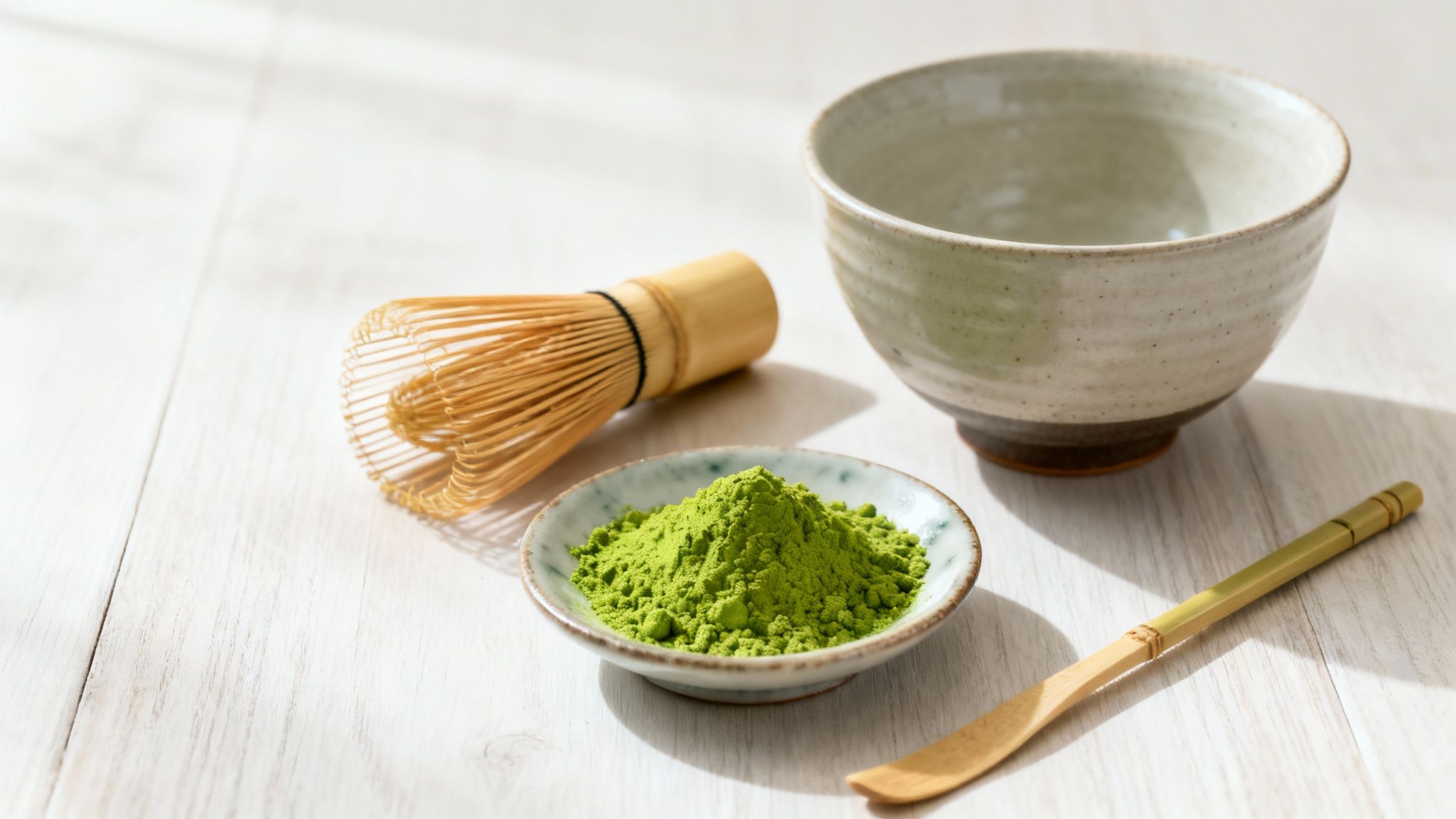
You could improvise, but using the traditional tools makes the whole process smoother, more enjoyable, and guarantees a better result. Think of them as your partners in this daily ritual.
Here’s what you’ll need:
- Chawan (Matcha Bowl): A wide, flat-bottomed bowl specifically designed to give you plenty of room for a good, frothy whisk.
- Chasen (Bamboo Whisk): This is non-negotiable. Its 100-plus delicate, flexible tines are expertly crafted to aerate the tea and create that signature creamy froth.
- Chashaku (Bamboo Scoop): The traditional way to measure out the perfect amount of matcha for one serving.
- Fine-Mesh Sieve: An absolute must for avoiding clumps and achieving a silky-smooth texture every single time.
Understanding why each tool exists is the first step. The chawan isn't just a bowl; it's your canvas. The chasen isn't just a whisk; it's the instrument that breathes life into the tea. When you embrace these elements, making matcha transforms from a simple task into a practice you’ll look forward to.
Preparing Traditional Usucha: The Everyday Bowl
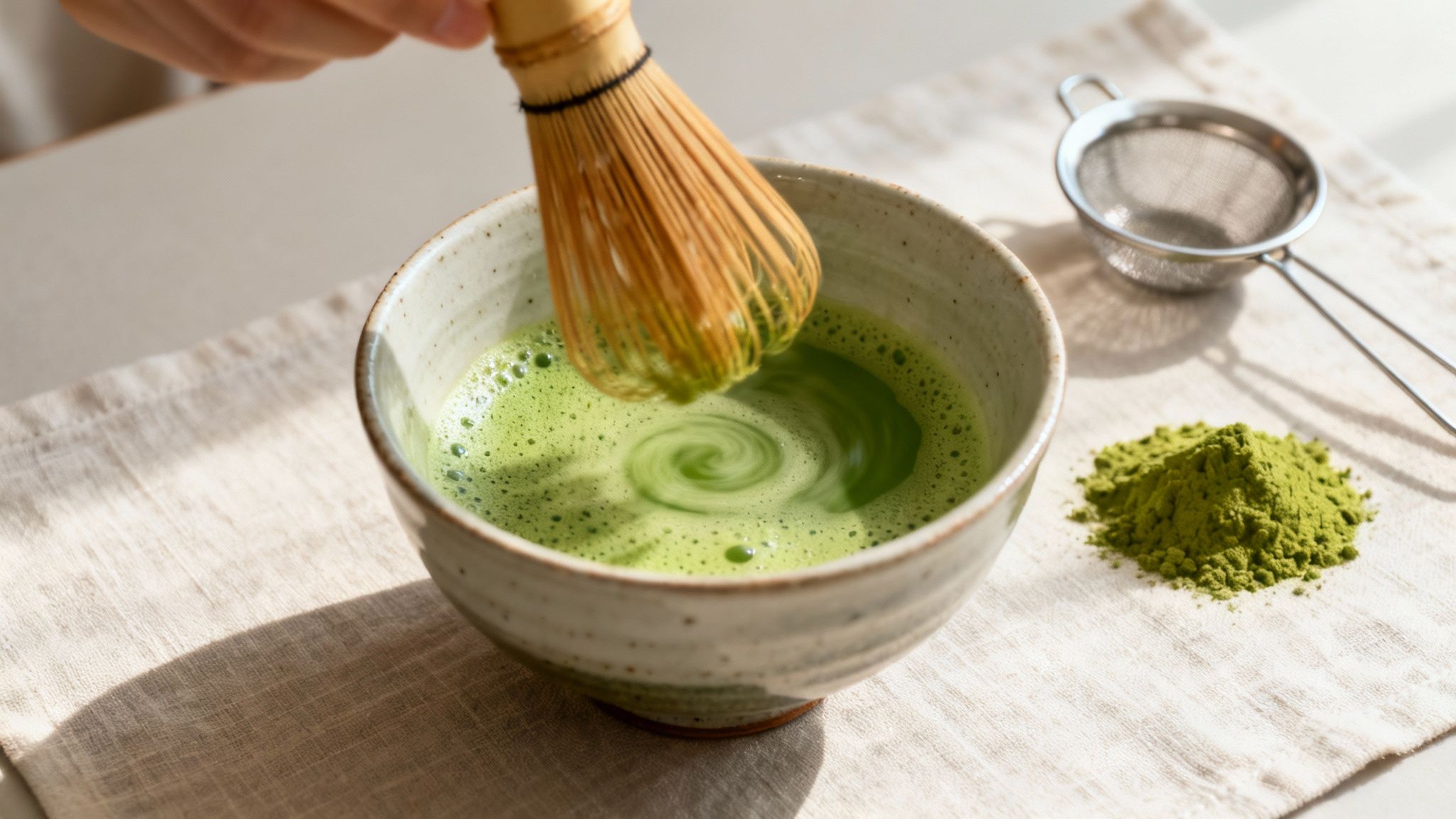
This is where the real journey begins. Usucha, or 'thin tea', is the way most people enjoy matcha every day. It’s that moment of vibrant, frothy perfection that gives you a calm, focused energy. The process itself is quite simple, but it's the tiny details that turn a good bowl of matcha into a truly exceptional one.
We're going to walk you through the subtle steps that make all the difference. Forget basic instructions; we’ll share the techniques that create a consistently smooth, flavourful, and beautiful cup, every single time. It's less about a rigid recipe and more about understanding the 'why' behind each movement.
The Crucial First Step: Sifting Your Matcha
If you only take one piece of advice from this guide, let it be this: always sift your matcha. It's the single most important thing you can do to avoid clumps. Matcha powder is so finely ground that it’s prone to static electricity, causing it to form tiny clusters that are almost impossible to whisk out once you add water.
Sifting breaks up these clumps and aerates the powder, just like sifting flour for a cake. The result? A much smoother, creamier texture and a richer, more stable froth. This is a 20-second step that makes a world of difference to the final quality of your tea.
Just place a small, fine-mesh sieve over your chawan (bowl) and gently push the matcha through with your chashaku (bamboo scoop). You’ll see right away how light and airy the powder becomes.
Finding the Perfect Water Temperature
Here’s the second golden rule: never use boiling water. Water that’s too hot—anything over 80°C (176°F)—will scorch the delicate tea leaves. This triggers a chemical reaction that releases too many catechins and tannins, leaving you with a harsh, bitter flavour that completely masks the matcha's subtle sweetness and umami notes.
The sweet spot for usucha is between 70-80°C (158-176°F). It’s hot enough to dissolve the powder and unlock its full aroma, but gentle enough to protect its delicate, complex flavour.
Don't have a temperature-controlled kettle? No problem. Simply boil your water and let it sit for a few minutes. Another easy trick is to pour the boiled water into a separate cup first; this will cool it down quickly before you add it to your bowl.
The Ideal Ratio for Usucha
You can always adjust this to your own taste, but the traditional starting point for usucha offers a perfect balance. Think of it as your reliable baseline.
- Matcha: Two scoops with a traditional bamboo chashaku, which is about 2 grams or 1 teaspoon.
- Water: Roughly 70ml (about 2.5 ounces) of water at the correct temperature.
This ratio creates a brew that is flavourful and vibrant without being overpowering, allowing the sweet, grassy notes of a high-quality ceremonial grade matcha to really sing. For a deeper dive, our guide on preparing matcha tea has even more tips.
Mastering the Whisking Motion
This is where the magic happens. The aim is to create a fine, stable foam, not big, airy bubbles. A good froth is the hallmark of well-prepared matcha and gives it that signature creamy mouthfeel.
Forget stirring in circles. The proper technique is a quick, energetic 'W' or 'M' motion, powered by your wrist, not your whole arm.
- Start with a paste. Pour just a splash of your warm water over the sifted matcha. Whisk slowly to form a smooth, thick paste, making sure there are no dry spots at the bottom.
- Add the rest of the water. Pour in the remaining water.
- Whisk vigorously. Holding the chasen vertically, whisk back and forth in a rapid 'W' pattern. Keep your wrist loose and fast. You’re aiming for about 15-20 seconds of this.
- Finish gently. As the froth builds, raise the whisk closer to the surface and slow down. Gently trace a circle on the surface to break up any large bubbles, creating a uniform, velvety crema. Lift the whisk from the centre of the bowl.
And there you have it. Your perfect bowl of usucha is ready. Take a moment to appreciate its vivid colour and aroma before you take your first sip.
Mastering Koicha: The Ceremonial Thick Tea
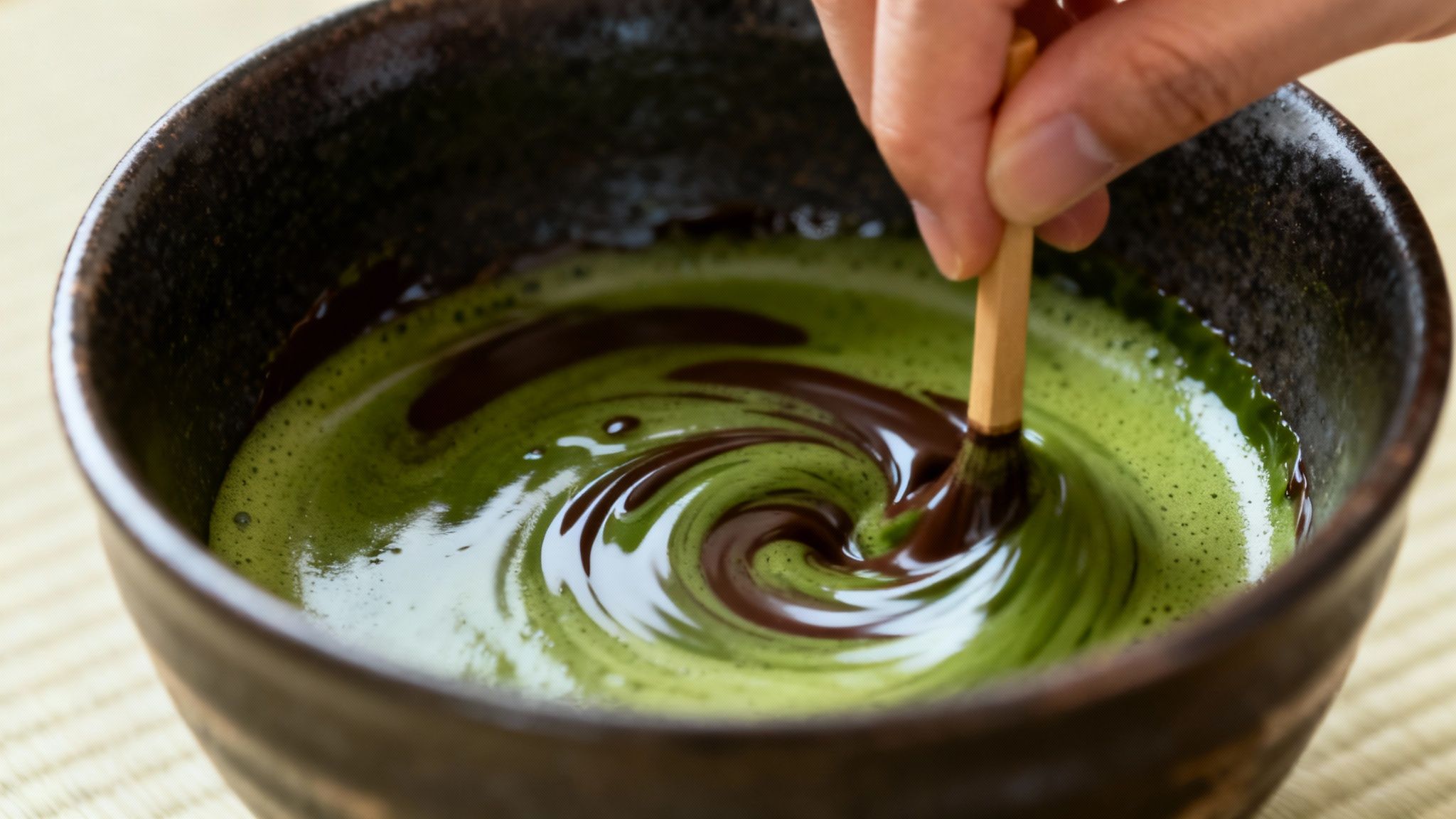
If Usucha is your vibrant, frothy daily brew, then Koicha—or 'thick tea'—is its profound, contemplative cousin. This is matcha at its most pure and intense, the centrepiece of formal Japanese tea ceremonies. Making Koicha is less about a frantic whisk and more about a slow, deliberate art.
There’s no hiding with Koicha; it demands the absolute highest quality ceremonial grade matcha. Its thick consistency magnifies every tiny nuance of flavour, and any hint of bitterness from a lesser grade would be completely overwhelming. If you want to explore this deeper side of matcha, starting with the right powder is non-negotiable. To get a better sense of this, you can explore the different types of matcha tea and see for yourself why the grade matters so much.
The Distinct Koicha Ratio
The real secret to Koicha is the ratio of matcha to water. Where Usucha is light and airy, Koicha is rich and viscous, with a texture often compared to warm honey or melted dark chocolate.
To get there, the proportions are flipped on their head:
- Matcha: Use four scoops from your chashaku, which is about 4 grams or 2 teaspoons.
- Water: You only need 30-40ml of water, kept in that sweet spot of 70-80°C.
This ratio—double the powder and half the water of Usucha—creates a potent brew that’s deeply satisfying. It’s not a drink you gulp down. Traditionally, a single bowl of Koicha is shared among guests, with each person taking a single, respectful sip from the same chawan.
The Kneading Motion Technique
Forget the rapid 'W' or 'M' motion you’ve perfected for Usucha. Preparing Koicha is a whole different ball game. The aim here isn’t to create froth but to gently and meticulously blend a large amount of powder into a tiny volume of water, creating a perfectly smooth, glossy liquid.
It’s all about a slow, deliberate kneading motion.
First, sift your powder. This step is absolutely crucial for Koicha. Sift all 4 grams of your ceremonial matcha into the bowl to get rid of any potential clumps.
Next, add all the water at once, pouring the 30-40ml of warm water directly onto the sieved powder.
Now, begin kneading. Take your chasen and gently press the powder into the water. Move the whisk slowly and deliberately around the bowl—up and down, side to side—as if you were kneading a tiny dough. While you do this, slowly rotate the bowl with your other hand to ensure every last particle is incorporated.
The process is finished when you have a perfectly smooth, thick mixture with a beautiful glossy sheen. This whole kneading process should only take about a minute.
The key here is patience. If you rush, you’ll end up with lumps. Think of it more like painting than whisking; your movements should be fluid and controlled, creating a seamless blend.
Appreciating The Flavour Of Koicha
A perfectly made bowl of Koicha is a remarkable experience for the senses. Because you’re using the finest tea leaves available, the flavour is incredibly complex and rewarding. Instead of bitterness, you’re greeted with an intense wave of umami—a deep, savoury richness that completely coats your palate.
This savouriness soon gives way to a profound, lingering natural sweetness that you’ll only find in top-tier matcha. The thick, almost syrupy texture just amplifies these notes, making each small sip a truly memorable event. It’s a meditative ritual that asks for your full attention, rewarding you with the purest expression of what matcha can be.
Exploring Modern Matcha Lattes and Recipes

While a traditional bowl of Usucha or Koicha is a beautiful, meditative ritual, matcha's true versatility shines when it steps into the modern kitchen. Its uniquely earthy, umami-rich flavour makes it a brilliant partner for all sorts of ingredients.
This is where your culinary grade matcha comes into its own. Its character is bolder, more assertive, and specifically designed to stand up to other flavours, making it the go-to for lattes, smoothies, and baking. Let's look at how to bring this vibrant green powder into your daily routine.
The matcha latte is now a café classic, and for good reason. Its creamy texture and balanced flavour are a comforting yet invigorating alternative to coffee. It works just as well hot in the winter as it does iced in the summer, which is why it's become a key menu item for UK cafés. It’s a clear sign that matcha has moved from a niche interest to a mainstream favourite. You can read more about its growing popularity in this piece on UK matcha price trends and market acceptance.
Crafting the Perfect Matcha Latte
Making a café-quality matcha latte at home is much easier than you might think. The real secret is to first make a smooth, concentrated matcha 'shot' before adding your milk. This ensures you get a silky, clump-free drink every single time.
For a Hot Matcha Latte:
- Make the Matcha Shot: Sift 1 teaspoon (2g) of culinary grade matcha into your bowl. Pour over 60ml of hot water (around 80°C) and whisk until it's completely smooth and frothy.
- Steam Your Milk: Gently heat and froth 180-200ml of your milk of choice. Oat milk is fantastic as its natural creaminess is a perfect match for the tea, but almond, soy, and dairy milk all work wonderfully.
- Combine and Serve: Pour the matcha shot into your mug. Slowly pour in the steamed milk, holding back the foam with a spoon at first, then spooning the rest on top.
If you like it a little sweeter, add a drizzle of honey or maple syrup to the matcha shot before pouring in the milk.
Mastering the Iced Matcha Latte
On a warm day, there’s nothing quite like a perfectly layered iced matcha latte. Getting that stunning visual effect—the vibrant green cascading into the creamy white milk—is all about how you assemble it.
For that beautiful layered look, always pour the matcha shot into the milk, not the other way around. The denser, colder milk stays at the bottom, letting the lighter matcha float on top until you're ready to stir.
How to make it:
- First, prepare your matcha shot just like you would for a hot latte, then set it aside to cool for a minute.
- Next, fill a tall glass with plenty of ice and pour in 180-200ml of cold milk.
- Slowly pour the cooled matcha shot over the milk and ice.
- Take a moment to admire the layers, then give it a good stir just before you take the first sip.
Beyond the Latte: Culinary Creations
Matcha’s potential goes far beyond drinks. Its complex, slightly sweet flavour profile pairs beautifully with a whole host of ingredients, making it an exciting addition to your baking.
Think of these flavour pairings as a jumping-off point for your own kitchen experiments:
- White Chocolate: The creamy sweetness is a perfect foil for matcha’s slight bitterness. Try adding a teaspoon of matcha to your favourite white chocolate chip cookie recipe.
- Coconut: The tropical notes of coconut milk or desiccated coconut create a wonderfully fresh combination. A matcha and coconut smoothie is a fantastic way to start the day.
- Citrus: The bright acidity of lemon or lime cuts through the richness of the matcha. A simple matcha shortbread with a zesty lemon glaze is an absolute winner.
You can even get creative without turning the oven on. Try rolling a blend of oats, dates, culinary matcha, and coconut into little energy balls for a quick, healthy snack. The possibilities really are endless once you start thinking of matcha as a flavour in its own right.
Sourcing and Storing Your Matcha
That vibrant green powder you’ve just brought home is delicate. Think of it as a fresh ingredient, because that’s what it is. From the moment it's ground, matcha’s flavour and health benefits are at the mercy of its three greatest enemies: oxygen, light, and heat. This means getting your hands on high-quality matcha and storing it properly is every bit as important as how you whisk it.
Knowing what to look for when buying is your first challenge. Real, top-tier matcha—especially ceremonial grade—comes from very specific regions in Japan, with Uji being the most revered. The colour should be a vivid, almost electric green. If it’s dull, or has a yellowish tinge, it's likely a lower grade or, worse, old stock. The powder itself should feel impossibly fine and silky, like talc.
The UK matcha market is exploding, with its value expected to hit £71.2 million by 2030. That boom means there's more choice than ever, but it also means you have to be more discerning to find the good stuff. If you’re curious, you can dig into the data on the UK's expanding matcha market trends to see why quality sourcing is becoming so crucial.
Where to Keep Your Matcha Before You Open It
Consider your unopened tin of matcha precious cargo. Before you break that seal, the absolute best place for it is the refrigerator. The cool, dark environment drastically slows the degradation process, locking in that fresh, umami-rich flavour for much longer.
Just one important tip: when you're ready to use it, pull the tin out of the fridge and let it sit for a couple of hours to come to room temperature. This is a non-negotiable step. It stops condensation from forming inside when you open it, which would introduce moisture and turn your silky powder into a clumpy mess.
Think of your matcha like you would fresh spinach. You wouldn't leave it wilting on the counter, so don't leave your matcha exposed to the elements in your kitchen.
Proper storage protects the investment you've made in a premium powder. This is true for all high-quality teas, not just matcha. For a deeper dive, check out our guide on the best storage practices for tea to keep all your favourite blends in top condition.
How to Store Your Tin After Opening
The moment you open your matcha, oxygen becomes its biggest threat. The countdown to peak freshness has officially begun. At this point, it’s time to move it out of the fridge. The constant temperature fluctuations from taking it in and out will create condensation, which is the enemy of fine powder.
From here on out, consistency is key. You're looking for a stable, steady home for your tin.
- Find a Cool, Dark Spot: A kitchen cupboard or pantry works perfectly, as long as it's away from the oven, hob, or any sunny windowsills.
- Keep it Airtight: This is a simple one, but so important. Make sure the lid is sealed tightly after every single use to keep as much air out as possible.
- Use It Quickly: To enjoy the best flavour, aroma, and colour, you really want to finish your tin within 3-4 weeks of opening it.
Of course, it will still be perfectly fine to drink for a few months, but you'll notice that vibrant complexity starts to fade after that first month. Follow these simple rules, and you'll ensure every bowl you make is as fresh and delightful as it was meant to be.
Your Common Matcha Questions Answered
Even when you follow the steps, a few questions always pop up as you get into the rhythm of making matcha. Think of this as your go-to guide for troubleshooting those little hitches that can get in the way of a perfect bowl.
Getting the small details right is what transforms a good cup of matcha into a great one. We’ll tackle everything from frustrating clumps to that unexpected bitter note, making sure every sip is as smooth and rich as it should be.
Why Is My Matcha Clumpy?
This is easily the most common snag people run into. Those little clumps are caused by static and moisture in the air, which makes the ultra-fine powder stick together. Thankfully, the fix is wonderfully simple.
The best thing you can do for a silky-smooth matcha is to sift it through a fine-mesh sieve before adding any water. This one small step breaks up any clumps and aerates the powder, setting you up for a much better consistency and a creamier froth.
No sieve to hand? Don’t panic. Just use your bamboo scoop (chashaku) to press the powder firmly against the side of the bowl. Add a tiny splash of your warm water and mix it into a thick, even paste. Then, add the rest of the water and whisk as usual.
What Makes My Matcha Taste Bitter?
A high-quality ceremonial matcha, prepared correctly, should have absolutely no bitterness. If you’re getting a sharp, astringent taste, it’s almost always down to one of three things:
- Water That’s Too Hot: This is the usual suspect. Any water above 80°C (176°F) will scorch the delicate tea, releasing too many tannins and creating a harsh flavour. Always give boiled water a few minutes to cool down.
- The Quality of Your Matcha: Lower-grade or old, stale matcha will naturally taste more bitter. This is why culinary grade is best kept for lattes and baking, where its robust flavour is balanced by other ingredients.
- The Wrong Ratio: Using too much matcha for the amount of water can easily overwhelm the palate. Try dialling back the powder just a little until you find a balance that suits your taste.
Can I Make Matcha Without a Bamboo Whisk?
While the traditional bamboo whisk, or chasen, is designed to create that signature frothy crema, you can definitely make do without one. If you’re just starting out or caught in a pinch, you’ve got a couple of good alternatives.
An electric milk frother is your next best bet. These handheld gadgets are brilliant for whipping the matcha and water into a decent froth in seconds. It’s a great modern shortcut.
If you don’t have a frother, a small jar with a tight-fitting lid works surprisingly well. Just add your sifted matcha and water, screw the lid on tight, and shake it vigorously for about 30 seconds. You won’t get the same velvety foam as you would with a chasen, but it mixes the powder perfectly and is ideal when you're on the move.
Ready to put this knowledge into practice with an exceptional tea? The journey to a perfect bowl of matcha always starts with the finest ingredients. Explore the exquisite ceremonial grade matcha from Jeeves & Jericho and experience the smooth, umami-rich flavour that will truly elevate your daily ritual. Discover your new favourite at https://www.jeevesandjericho.com.