


First things first, let's get one common misconception out of the way. There's no such thing as a "breakfast tea plant." Breakfast tea is more like a master recipe, a carefully chosen team of black teas blended together to create something bold, rich, and invigorating. It's designed to be strong enough to give you a proper wake-up call and stand its ground next to a hearty breakfast.
What Defines a Breakfast Tea
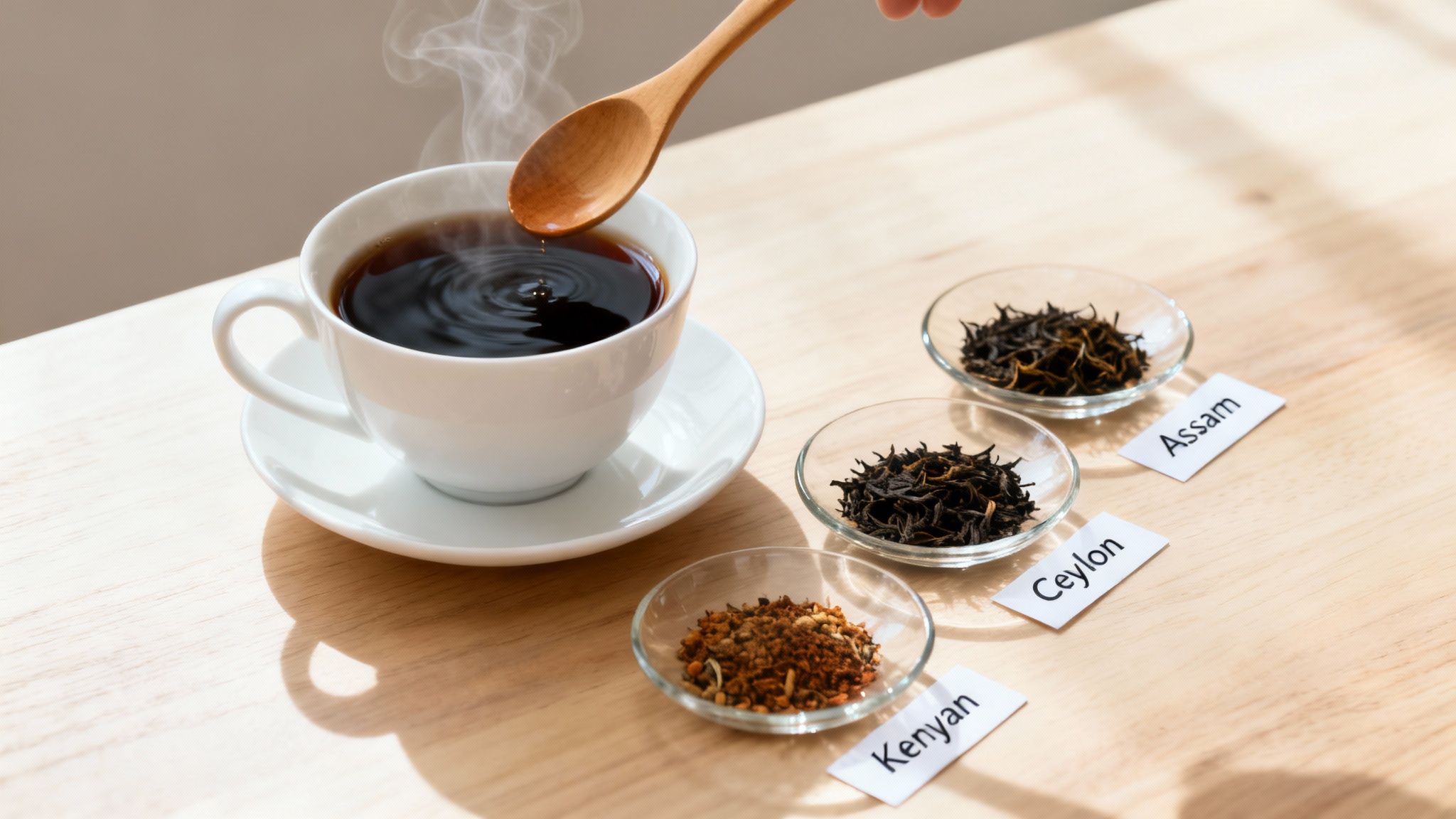
The real magic of a brilliant breakfast tea is all in the blend. Think of a master tea blender like a chef combining different ingredients to get a signature flavour just right. They expertly mix leaves from various regions to craft a powerful and, crucially, consistent taste. So, it's not one single type of tea, but an entire category built on this very principle.
This blending process is why your favourite morning cuppa tastes just as good in December as it did in July, smoothing out any natural variations that come with single-origin harvests. The aim is always the same: a full-bodied brew that doesn't lose its character when you add a splash of milk or a spoonful of sugar.
The Classic Tea Trio
Most breakfast blends you'll come across are built on a foundation of three classic black teas. Each one brings something special to the party:
- Assam: This is the heart of the blend. Hailing from India, Assam provides that deep, malty backbone and a lovely, rich colour.
- Ceylon: From Sri Lanka, Ceylon tea adds a bright, brisk quality. It’s the crisp, clean finish that cuts through the richness and keeps the blend feeling lively.
- Kenyan: Grown in East Africa, Kenyan leaves bring the muscle. They contribute a bold, robust character and that invigorating strength you expect from a breakfast brew.
Together, they create a wonderfully balanced, complex, and deeply satisfying experience. While there are countless different types of tea out there, it's this classic combination that gives breakfast tea its signature taste. Here in the UK, it’s still the undisputed cornerstone of our tea culture.
According to the 2025 UK Tea and Infusions Census Study, a remarkable 71% of Brits still prefer traditional black tea as their main infusion, highlighting its status as the nation's go-to morning brew. You can explore the full study about British tea habits to learn more.
This enduring popularity shows that breakfast tea is so much more than just a drink. For many of us, it’s a daily ritual, a familiar comfort designed to awaken the senses and get you ready for whatever the day has in store.
Tracing the Roots of Your Morning Ritual

The story of how breakfast tea landed in nearly every kitchen cupboard isn't just a simple timeline. It’s a brilliant tale of Scottish resourcefulness, a dash of royal approval, and the sprawling trade routes of the British Empire. It all began with a simple need for a stronger, more gutsy brew to get the day started properly.
Our journey kicks off not in an English drawing-room, but in 19th-century Scotland. The popular story points to a Scottish tea merchant, Robert Drysdale of Edinburgh, who in 1892 created what he called a "Breakfast Blend". His creation was wonderfully robust, blended specifically to stand up to a hearty Scottish breakfast and cut through the region’s soft water.
This punchy blend might have stayed a local favourite if it weren't for a bit of royal intervention. Queen Victoria, while staying at her Scottish estate, Balmoral, is said to have tried Drysdale’s creation and was completely smitten. So much so, she took a personal stash back home with her to England.
From Scottish Blend to English Staple
Once the Queen started pouring it, the blend’s popularity exploded among the English aristocracy. London's tea merchants, ever keen to follow a trend, quickly started mixing their own versions. As its fame grew south of the border, the brew picked up the nickname "English Breakfast Tea"—a name that’s clearly stuck around.
This surge in popularity happened at the perfect moment, right as the British Empire was expanding its reach. New trade routes were opening up, giving blenders access to fantastic tea-growing regions that would completely change the character of the cuppa.
- Assam, India: This is where breakfast tea gets its backbone. The dark, malty leaves from Assam provided the signature strong base.
- Ceylon (Sri Lanka): Teas from Ceylon brought a bright, brisk quality to the mix, adding a lively and refreshing edge.
- Kenya, Africa: Later on, bold and full-bodied Kenyan teas joined the party, contributing depth and a rich coppery colour.
These incredible new ingredients gave tea masters the tools to craft blends with more complexity and consistency than ever before. It was the perfect storm of smart blending, a royal seal of approval, and global trade.
What began as one man's solution in a Scottish shop grew into a beloved British institution. The journey of breakfast tea is really a story of the era's growing global connections, turning a local recipe into the world's go-to morning ritual.
This history lesson perfectly answers the question of what is breakfast tea today: it’s a dynamic blend with Scottish roots, an English title, and a rich, bold flavour built from the finest teas around the globe. It was born to be strong, satisfying, and the very best partner for the first meal of the day.
Decoding the Great Breakfast Blends
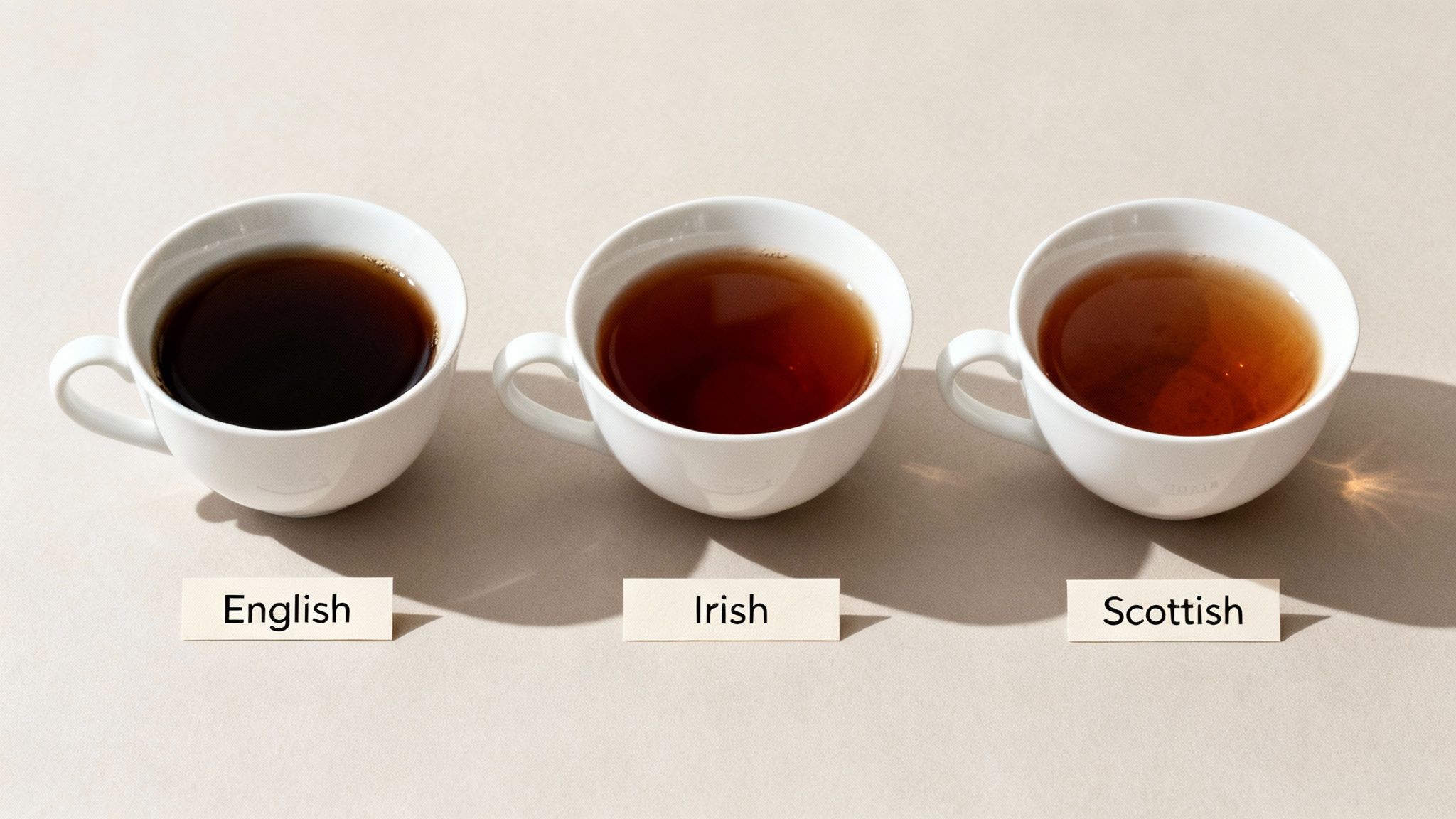
When we talk about "breakfast tea," it's easy to picture a single, definitive brew. But the reality is far more interesting. It's not one tea, but a whole family of blends, each with its own distinct personality.
The three most famous members of this family are English, Irish, and Scottish Breakfast teas. Each was originally crafted to suit local tastes and, fascinatingly, the local water hardness. This means that while they all aim to be a robust morning cuppa, they vary quite a bit in flavour and strength.
The Balanced English Breakfast
This is the blend most people immediately think of. English Breakfast is the quintessential all-rounder, loved for its bright, full-bodied, yet perfectly balanced flavour. It’s got enough kick to wake you up properly, but it’s smooth enough not to overwhelm the senses.
This harmonious character comes from a classic combination of leaves:
- Hearty Assam for that signature malty depth.
- Bright Ceylon to add a crisp, lively finish.
- Robust Kenyan teas to provide strength and a rich, coppery colour.
It’s the reliable go-to, the perfect partner for a full English. If you want to get into the nitty-gritty of its story, you can find out more about what tea is English breakfast tea in our detailed guide.
The Malty Irish Breakfast
If English Breakfast is the balanced diplomat, then Irish Breakfast is its bolder, more assertive cousin. The Irish are among the world's most dedicated tea drinkers, and their favourite blend reflects a love for a truly powerful brew. It has a distinctly strong, malty flavour and a signature reddish hue.
The secret to its strength is a heavy dose of Assam tea leaves. This gives it a rich, gutsy character that stands up brilliantly to a proper splash of milk—just how many Irish tea drinkers prefer it.
The Bold Scottish Breakfast
Of the three, Scottish Breakfast is usually the boldest and most potent of the lot. It was originally blended to be strong enough to punch through Scotland's famously soft water, which can otherwise make tea taste a bit weak or flat. To get around this, blenders created a blend with incredible oomph and a brisk, invigorating character.
This blend is the heavyweight champion of breakfast teas. It often contains a powerful mix of teas from Assam and Kenya, sometimes with leaves from other regions like China or Indonesia, all picked for their sheer strength and ability to deliver a full-bodied, no-nonsense cup every single time.
What Goes Into the Perfect Cup?
Ever stop to think about what makes that first sip of morning tea so ridiculously satisfying? It’s not just about dunking a bag in hot water; there’s a whole lot of chemistry going on in your mug. The rich colour, the deep flavour, and that welcome kick of energy are all down to a fascinating dance of natural compounds.
Getting to grips with this a little bit transforms you from someone who just drinks tea to someone who truly appreciates it. The distinct personality of any breakfast blend comes directly from the leaves inside. Those lovely malty, biscuity notes? That’s the classic signature of Assam tea, which gives most blends their strong, reliable backbone. And that bright, almost zesty quality that cuts through it all? That’ll be the Ceylon leaves, lifting the whole experience and stopping it from feeling too heavy.
Let’s Talk About Tannins
One of the main players in this whole affair is a group of compounds called tannins. They’re a type of polyphenol found naturally in tea leaves, and they’re behind two of the most obvious things you’ll notice in your morning brew:
- Colour: Tannins are what give black tea its gorgeous, deep reddish-brown hue. The longer you let it steep, the more tannins are released, and the darker your tea becomes.
- Astringency: You know that slightly dry, mouth-coating feeling you get on your tongue? That’s astringency, and it's all down to tannins. It’s the very same sensation you’d find in a good glass of dry red wine. This is what gives the tea structure and helps it cut through the richness of a proper fry-up.
While they’re essential for a full-bodied cup, too many tannins can make your tea taste bitter. This is exactly why getting your brewing time right is so important – you want to coax out enough for colour and flavour without going overboard.
That All-Important Caffeine Kick
Of course, we can’t talk about breakfast tea without talking about caffeine. For many of us, it’s the whole point of that first cup. So, how does it stack up against coffee, and what changes how much of it ends up in your mug?
An average 235ml cup of breakfast tea will give you somewhere between 40 and 70 milligrams of caffeine. That’s roughly half of what you’d get from the same size cup of filter coffee, which usually sits between 95 and 165 milligrams. It’s a much more gentle way to wake up, giving you a lift without the jittery feeling a strong coffee can sometimes bring on.
Interestingly, the caffeine in tea works a bit differently. It actually binds to the tannins, which means your body absorbs it more slowly. The result is a smoother, more sustained sense of focus, rather than that classic coffee spike and subsequent crash.
A few things can affect the final caffeine count in your cup. How long you brew it is a big one; a five-minute steep will naturally have more caffeine than a two-minute one. The size of the leaves also plays a part. Smaller, broken leaves (like the fannings in many tea bags) have more surface area, so they release caffeine much faster than larger, whole leaves. It's this delicate balance of flavour, that tannic grip, and a gentle caffeine lift that makes breakfast tea such a perfect way to start the day.
How to Brew a Flawless Cup Every Time
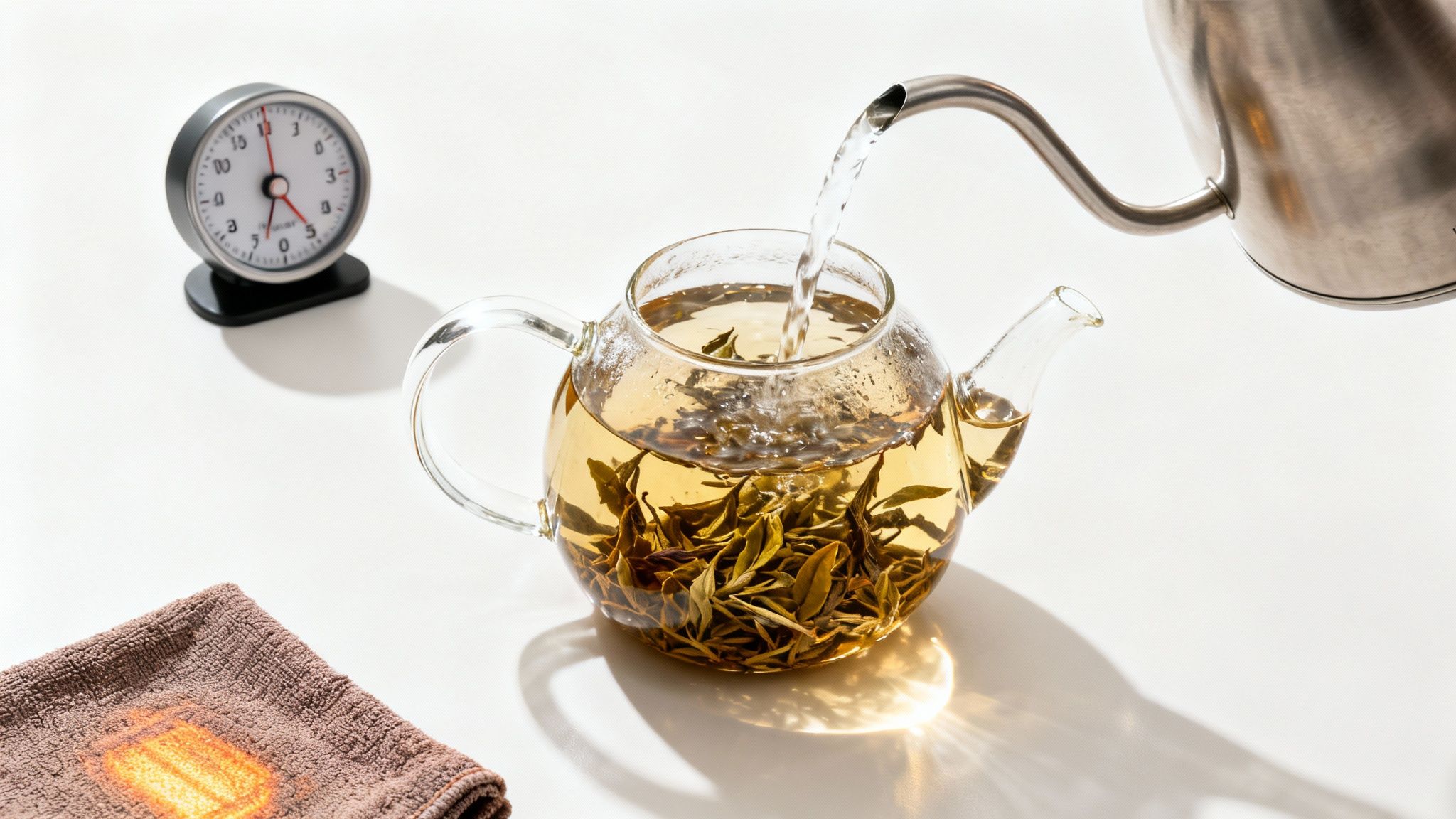
Turning your daily brew from a simple habit into a perfected ritual is easier than you might think. It really just comes down to getting the basics right, and a few small tweaks can unlock a consistently rich and satisfying flavour.
First thing’s first: the water. It might sound obvious, but always use freshly drawn, cold water and bring it to a full, rolling boil (100°C). Re-boiling water that’s been sitting in the kettle strips it of oxygen, which can leave your tea tasting disappointingly flat.
Here’s a simple trick that makes all the difference: warm your teapot or mug beforehand. Just give it a quick swirl with a bit of hot water from the kettle and pour it out before adding your tea. This little step keeps the brewing temperature from dropping, helping the leaves to fully unfurl and release all their wonderful flavour.
Mastering the Brew
With your water sorted, the next crucial part is timing. For most breakfast tea blends, you’re aiming for a steeping window of 3 to 5 minutes. Any less, and you’ll have a weak, underwhelming cup. Any longer, and you risk releasing too many tannins, which is what makes tea taste bitter. Getting the measure of your leaves right is just as important, and you can find more detail on things like precise teaspoon measurements to help you along.
While tea bags are undeniably convenient, they often contain smaller leaf particles that brew quickly but can lack real complexity. For a truly superior cup, nothing beats whole loose-leaf tea. It just offers a far more nuanced and aromatic experience. If you’re new to it, our guide has some great tips on how to brew loose leaf tea.
Now, for the age-old debate: milk in first or last? Tradition holds that adding milk after the tea lets you properly judge the strength and colour of your brew. From there, add a spot of sugar or a slice of lemon if that’s your thing, and you’ve crafted the perfect cup.
Your Breakfast Tea Questions, Answered
Right, so we've journeyed through the history, uncovered the different blends, and even peeked behind the curtain at the science of a proper brew. But there are always a few lingering questions that pop up. Let's get them sorted.
Think of this as your go-to guide for those final curiosities. Clear, simple answers to turn you from a tea drinker into a true breakfast tea connoisseur.
English Breakfast vs Earl Grey: What's The Difference?
This is easily one of the most common questions we hear, and the answer is all about one simple thing: flavouring.
English Breakfast is a pure blend of black teas. Its whole identity—that robust, malty, full-bodied character—comes directly from the leaves themselves, often a carefully balanced mix of Assam, Ceylon, and Kenyan teas. It's the unadulterated, powerful expression of black tea, blended for richness and oomph.
Earl Grey, on the other hand, takes a black tea base (often a bit lighter than a breakfast blend) and infuses it with the oil of bergamot orange. That single addition is what gives Earl Grey its famous floral, citrusy aroma and a taste that’s in a completely different world.
To put it simply: English Breakfast is a strong, straight-up black tea blend. Earl Grey is a black tea that's been flavoured with citrus. They're two fundamentally different cups of tea.
Can I Drink Breakfast Tea All Day?
Absolutely! Don't let the name fool you. While its hearty profile and decent caffeine kick make it the perfect partner for your morning toast, its appeal certainly doesn't switch off at noon.
Plenty of people reach for a breakfast tea in the afternoon. It's that classic 'builder's brew' for a reason—perfect for tackling the post-lunch slump and getting your focus back. It just works.
A little word of warning, though, for anyone sensitive to caffeine. Thanks to its stimulating nature, you might want to switch to a herbal cuppa or a decaf in the evening. You know, just to make sure you get a proper night's sleep.
Is Breakfast Tea Good For Your Health?
When you enjoy it as part of a balanced lifestyle, breakfast tea can certainly have its perks. Like other black teas, it’s packed with natural plant compounds called flavonoids, which act as powerful antioxidants.
Some studies suggest these flavonoids are good for your cardiovascular health, potentially helping with circulation and reducing certain risk factors.
And of course, there's the caffeine. That moderate amount in your breakfast brew is brilliant for sharpening your focus and giving you a gentle mental lift, without the jarring jolt some people get from a strong coffee. As with anything, the key is moderation and being mindful of how much milk or sugar you're adding to the mix.
Why Does My Breakfast Tea Taste Bitter?
Ah, the dreaded bitter brew. This is a problem we see all the time, and thankfully, the fix is incredibly simple: you're over-steeping it.
That harsh, mouth-puckering taste comes from releasing too many tannins from the tea leaves. When you let your tea bag or loose leaves sit in hot water for too long—usually anything over five minutes—these astringent compounds take over, completely masking the lovely, malty notes you're supposed to be tasting.
Here are the two golden rules for a bitterness-free cup:
- Watch the clock: Always brew your breakfast tea for 3 to 5 minutes. That's the sweet spot for perfect flavour and strength without the bitterness.
- Don't steep longer for strength: If you like a stronger brew, leaving it for ten minutes is not the answer. Just use a bit more tea to start with. You'll get that robust flavour you're after, but the brew will stay smooth and balanced.
Of course, beyond mastering tea, many morning rituals also involve coffee. For those running a business, knowing about the best coffee machines for cafes is just as crucial. Getting your morning drink right, whether it's tea or coffee, sets the tone for the entire day.
At Jeeves & Jericho, we believe a truly exceptional cup starts with the finest whole leaves, ethically sourced and expertly blended. Explore our collection of premium breakfast teas to discover a richer, more flavourful morning ritual.