


Before it ever becomes the vibrant green latte we know and love, matcha begins an incredible journey, one steeped in centuries of Japanese tradition. So, how is matcha made? It all starts with special green tea leaves that are shade-grown to boost flavour, then carefully steamed, dried, de-stemmed, and finally, slowly stone-ground into a powder finer than silk.
A Tradition of Artistry and Precision
Creating exceptional matcha is a lot like producing a fine wine. Every single step—from the rich soil in Uji, Japan, to the patient, final grind—has a profound impact on the final cup. This isn't just about drying and crushing leaves; it's a deliberate, artful practice designed to cultivate that unique combination of brilliant colour, deep umami flavour, and a wealth of beneficial compounds.
In this guide, we'll walk you through each fascinating stage of the process. We’ll peel back the curtain on the authentic methods our partners use to produce the exceptional matcha for Jeeves & Jericho, revealing the true artistry behind every sip.
The Four Key Stages
To get to grips with how matcha is made, it helps to understand the four core phases of its production. Each one builds on the last, adding a specific quality to the final powder. These aren’t just steps in a recipe, but pillars of a tradition that has been perfected over generations.
- Shading: This is the foundational step that sets matcha apart from every other green tea, fundamentally changing the leaf's chemistry for the better.
- Harvesting: A highly selective process where timing and choosing the right leaves are absolutely critical for achieving that signature smoothness and flavour.
- Processing: What happens immediately after the harvest is crucial. This stage is designed to halt oxidation, locking in the leaves' brilliant colour and nutrients.
- Grinding: The final, almost meditative transformation from a processed leaf to a silky powder, requiring special granite stone mills and immense patience.
To truly appreciate matcha is to understand the journey from field to whisk. It’s a process where patience isn't just a virtue; it's an essential ingredient.
The table below gives you a quick overview of these essential steps before we dive into each one in more detail.
The Four Key Stages of Matcha Production at a Glance
| Stage | Purpose | Key Outcome |
|---|---|---|
| Shading | To increase chlorophyll and L-theanine levels. | Vibrant green colour and deep umami flavour. |
| Harvesting | To select only the youngest, most tender leaves. | Reduces bitterness and ensures premium quality. |
| Processing | Steaming to halt oxidation, then drying and de-stemming. | Preserves colour and nutrients, creating 'tencha'. |
| Grinding | Slowly milling tencha leaves between granite stones. | Creates an ultra-fine powder without heat damage. |
This snapshot shows just how much care goes into creating authentic matcha, turning a simple leaf into something truly special. Now, let's explore what really happens at each stage.
Cultivating Flavour in the Shade
The journey to a truly exceptional bowl of matcha begins long before a single leaf is plucked. It all starts in the fields with a deliberate and painstaking cultivation method that sets it apart from every other tea out there: shade-growing. This isn't just a quirky farming technique; it’s the foundational step that completely rewires the tea leaf's chemistry, crafting that signature vibrant colour and deep, complex flavour.
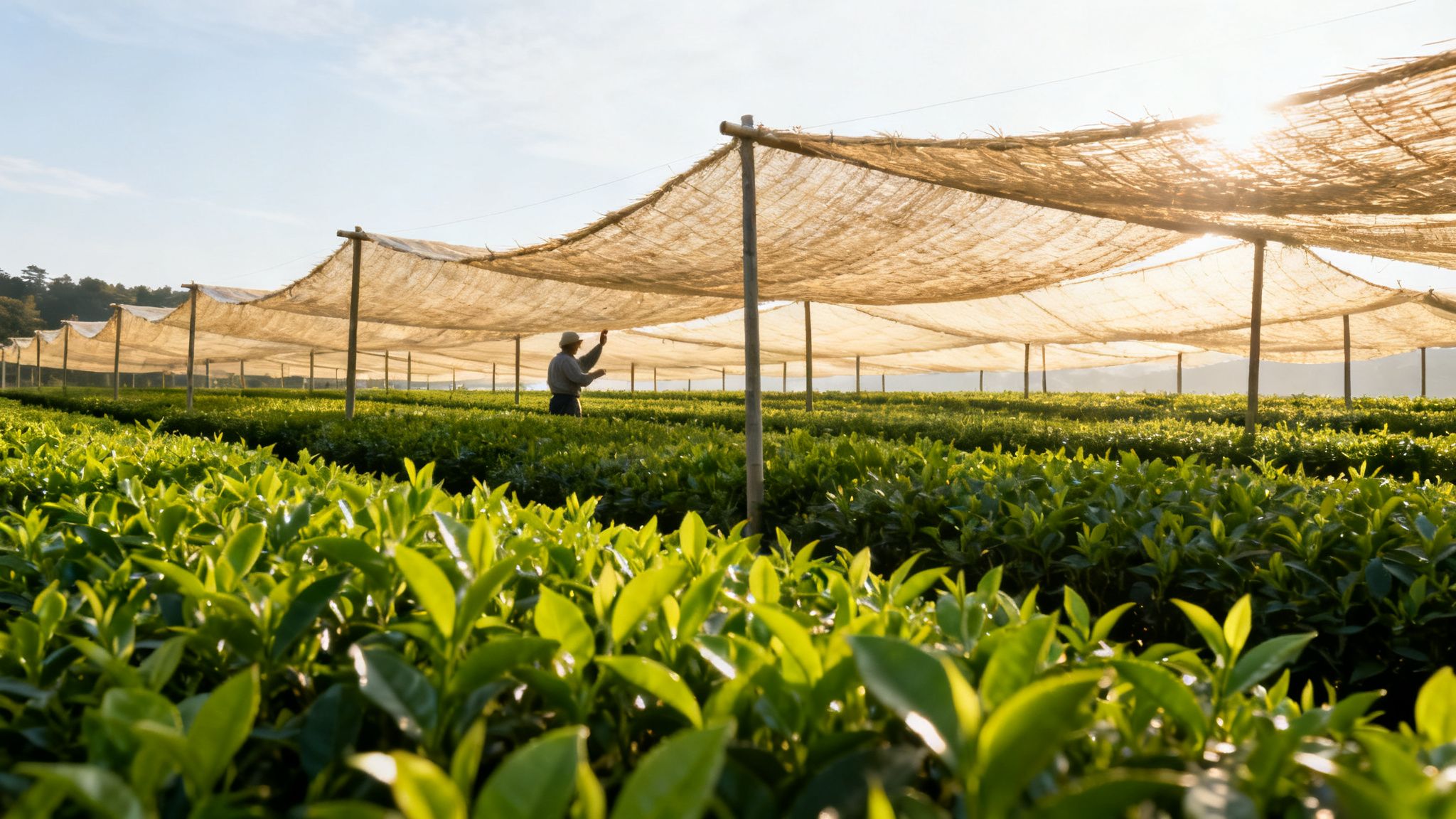
Think of it as putting the tea plant through a bit of training. For about 20 to 30 days before the spring harvest, farmers carefully cover the tea bushes with large screens—traditionally made of bamboo and reeds, though modern black vinyl is also common—shielding them from direct sunlight.
This simple act of deprivation triggers a remarkable chain reaction inside the leaves.
The Science Behind the Shade
Starved of sunlight, the Camellia sinensis plant kicks into survival mode. It starts frantically producing chlorophyll, the pigment that drives photosynthesis, in a desperate attempt to soak up every last drop of light. This is what gives high-grade matcha its almost impossibly vibrant, jade-green colour.
But the real magic happens at a molecular level. The shade dramatically slows down the conversion of an amino acid called L-theanine into catechins. Catechins are the compounds that give many green teas their characteristic bitter or astringent bite. By protecting the L-theanine, the leaves develop a flavour profile that is profoundly smoother, sweeter, and more complex.
This meticulous shading process is the secret behind matcha's sought-after 'umami'—that rich, savoury depth of flavour that lingers beautifully. It’s also what creates the calm, focused alertness matcha is so famous for, as L-theanine promotes relaxation without making you feel drowsy.
This appreciation for authentic, high-quality production is catching on. The UK matcha market, which hit USD 37.2 million, is expected to more than double to USD 77.5 million by 2033, fuelled by a growing demand for the good stuff. This is precisely where Jeeves & Jericho’s Uji-sourced matcha comes in. Our Yabukita cultivar plants are shaded under traditional screens, boosting their theanine content by an incredible 200-300% to deliver that signature calm-yet-focused energy.
From Tradition to Modern Practice
This shading technique, known as tana, has been refined over centuries, especially in Japan's legendary Uji region. You can dive deeper into its history in our guide to the origin of matcha tea. For the absolute highest grades of ceremonial matcha, farmers still use traditional bamboo and straw mats. While modern materials are often used today, the principle is exactly the same.
The results of shading are clear as day:
- Vibrant Colour: A surge in chlorophyll leads to a brilliant green powder.
- Enhanced Umami: Higher L-theanine levels create a deep, savoury sweetness.
- Reduced Bitterness: With fewer catechins, the taste is smoother and far less astringent.
- Boosted Nutrients: The process concentrates antioxidants and amino acids within the leaves.
This first step is arguably the most crucial part of how matcha is made. Without the patient art of shading, the tea leaves would simply never develop the unique character needed to become the silky, flavourful powder we all love.
Transforming Fresh Leaves into Tencha
Once the shade-grown tea leaves are perfectly ripe, it's all hands on deck. The harvest, known as ichibancha or "first tea," is a race against the clock where precision is everything. Farmers move through the rows, carefully hand-plucking only the youngest, softest, and most vibrant green leaves from the top of each plant.
This isn't just for appearances—it's what defines the final flavour. These tender new leaves are packed with L-theanine but haven't yet developed the bitter catechins you find in older, tougher leaves. This is the secret to matcha's signature smooth, sweet character and deep umami notes.
Locking in Colour and Flavour with Steam
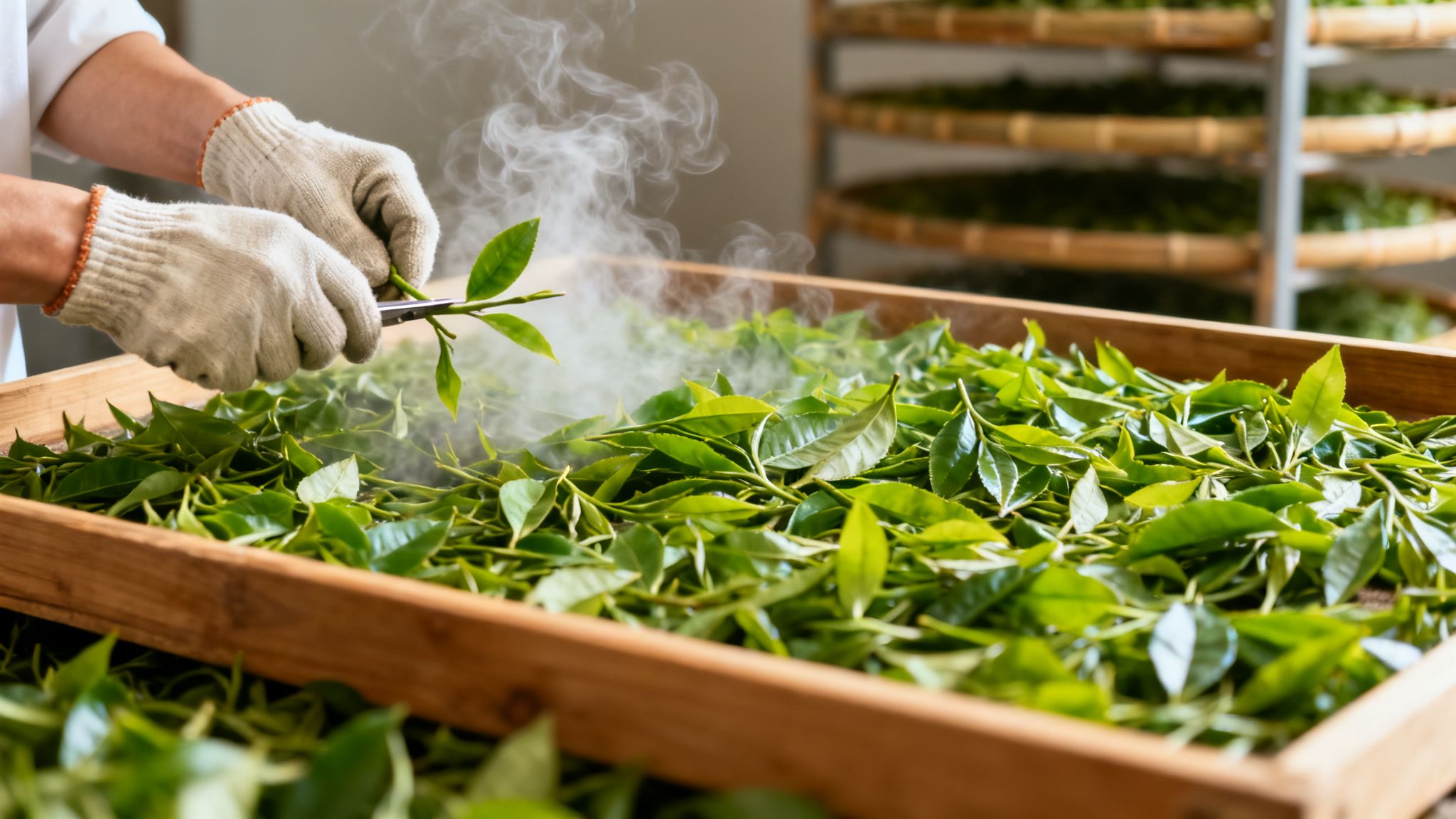
Within hours of being picked, the fresh leaves are rushed to be steamed. This is a blink-and-you'll-miss-it step, where the leaves are hit with a short, sharp blast of steam for just 15-20 seconds. It's a defining moment for all Japanese green teas and absolutely critical for matcha.
Think of it like blanching vegetables to keep their bright green colour. The steam instantly stops the enzymes that would otherwise cause the leaves to oxidise and turn brown, just like a cut apple. By halting this process, the farmers preserve that stunning jade green, the delicate aroma, and all the nutrients that developed during the shading period.
The steaming step is the moment a leaf’s potential is captured. It’s a precise, fleeting action that freezes the fresh, grassy character of the harvest, preventing it from ever becoming like a black or oolong tea.
This quick steam bath effectively seals in all the goodness, getting the leaves ready for the next stages.
Drying and Refining: The Birth of Tencha
After their quick steaming, the leaves are gently air-dried in large, multi-chambered machines. Warm air circulates, carefully reducing the moisture without scorching the delicate leaves. They come out flattened and dry, but they're still a long way from becoming matcha powder.
What comes next is probably the most painstaking part of the process. The dried leaves are tumbled and sifted through a series of machines that meticulously separate the soft leaf tissue from the tougher stems and veins. Getting rid of every last bit of stem and vein is what gives premium matcha its ultra-fine, silky texture.
The result is a flaky, deep green material called tencha. This is the raw ingredient for matcha—the pure flesh of the green tea leaf, with all the fibrous, bitter parts removed.
You can think of the journey to tencha in four key stages:
- Selective Harvesting: Only the youngest, most nutrient-rich leaves are picked.
- Immediate Steaming: A 15-20 second steam bath stops oxidation, locking in colour and flavour.
- Careful Air-Drying: The leaves are gently dried to remove moisture without damaging them.
- De-stemming and De-veining: All fibrous parts are meticulously removed, leaving only the pure leaf.
Only this purified tencha is worthy of being stone-ground. Every single step up to this point is designed to ensure that the final material is of the highest possible quality, ready to be transformed into that perfect, vibrant bowl of matcha.
The Art of Traditional Stone Grinding
After all that careful cultivation, harvesting, and refining, we finally arrive at the most crucial moment in making matcha. The flaky, refined tencha leaves are ready for their final transformation into that beautiful, vibrant powder we all know and love.
This isn’t about just blitzing the leaves. It’s a slow, deliberate art form, perfected over centuries.
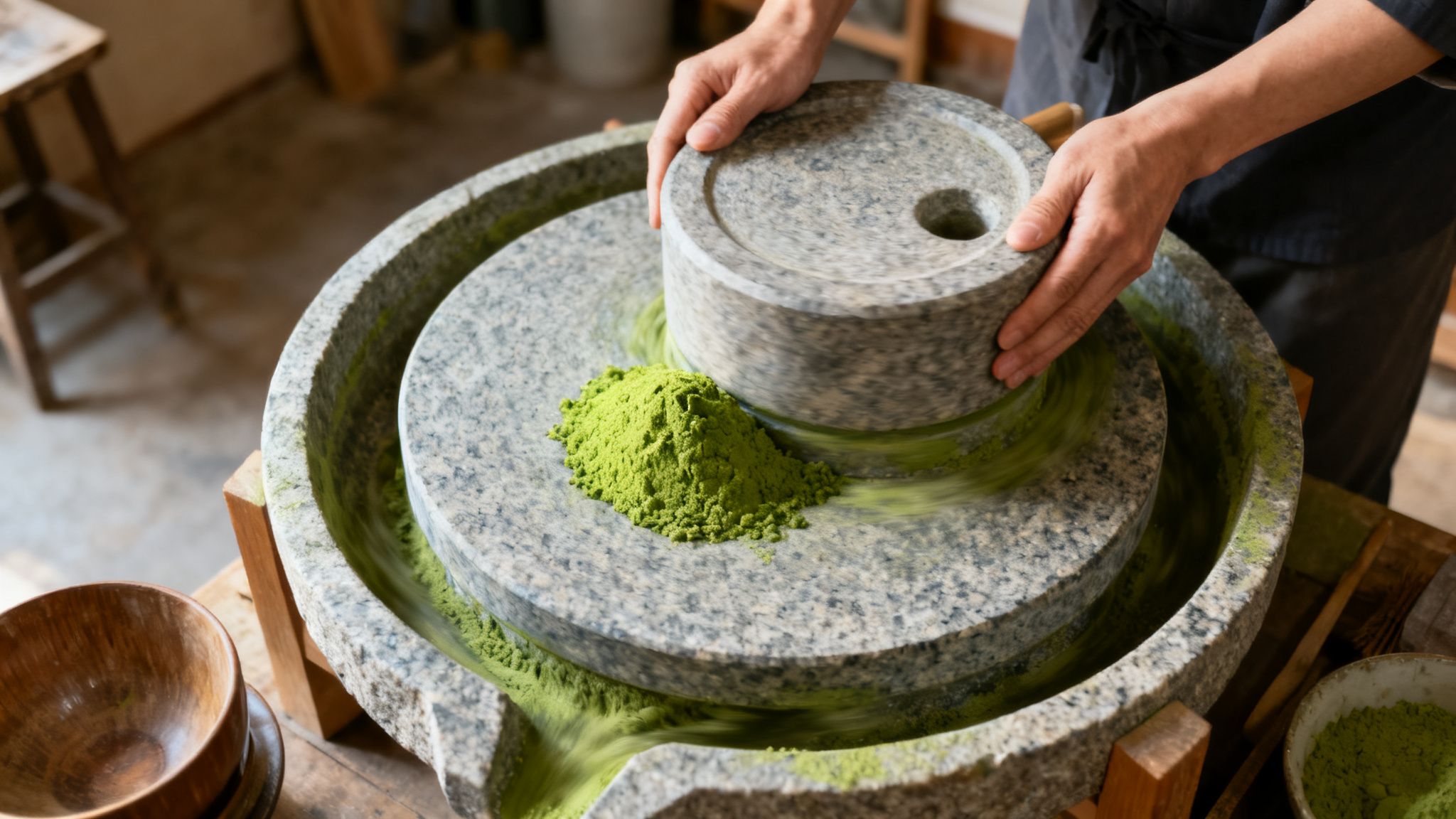
This incredible change happens thanks to traditional granite stone mills, or ishiusu in Japanese. These aren't just any old stones; they are hefty, precision-crafted tools, often weighing over 25 kilograms each. Inside, intricate grooves are carved to gently guide the tea leaves towards the centre.
The tencha is delicately poured into a hole at the top, and as the upper stone turns, the leaves are gently drawn between the two granite surfaces. The real magic is just how slow this process is. It's almost meditative.
Why Speed Is the Enemy of Quality
An ishiusu rotates at a snail's pace—roughly one turn a second. This incredibly slow speed is non-negotiable if you want to produce top-quality matcha. Any faster, and the friction would generate far too much heat.
That heat would essentially 'cook' the delicate tencha, scorching its fragile structure. The result? A dull, yellowish powder with a burnt, bitter taste. All the complex aromas, vivid colour, and rich nutrients so carefully nurtured during shading and processing would be completely lost.
The slow grind protects the very essence of the matcha. It is a testament to the idea that in traditional craftsmanship, patience is not just a virtue but an essential technique for preserving quality and flavour.
This painstaking method is so precise that it can take a full hour of continuous grinding to produce just 30 to 40 grams of ceremonial grade matcha. That’s barely enough for a few bowls. This dedication is what separates true, artisanal matcha from the mass-produced stuff.
The Result: A Microscopic Powder
The entire point of stone grinding is to create an exceptionally fine powder, typically between 5 and 10 microns. To give you some perspective, that's finer than talcum powder. This silky texture is what allows matcha to suspend perfectly in water, creating that smooth, creamy froth instead of a gritty sludge at the bottom of your cup.
This method is worlds apart from modern grinding techniques.
- Stone Grinding: Gently coaxes the leaves into a fine powder, keeping their cellular structure and nutrients intact.
- Industrial Grinding: Often relies on high-speed jet mills, which can create heat and result in a coarser, less vibrant powder.
While traditional ishiusu are central to matcha, understanding other grinding tools like the mortar and pestle helps illustrate the core principles of releasing flavour. Both use pressure and friction, but the stone mill is perfectly tuned for the unique delicacy of tencha.
Ultimately, the art of stone grinding is the final gatekeeper of quality. It's the bridge between the raw potential of the tencha leaf and the finished elegance of the final product, ensuring every single scoop delivers the authentic colour, flavour, and character it was always meant to have.
How to Spot a Truly Great Matcha
Once you understand the incredible journey matcha takes from the farm to your cup, you start to see what separates the good from the truly exceptional. When you’re looking for a great matcha, you'll quickly come across two main categories: Ceremonial grade and Culinary grade. These aren’t just marketing fluff; they point to real, tangible differences in how the tea was grown, picked, and ground.
Ceremonial grade is the absolute best of the best. It's crafted from the very youngest, most tender leaves from the first harvest of the year. The result is a flavour that’s naturally sweet, brimming with that sought-after savoury umami depth, and unbelievably smooth. This is the stuff you want to whisk with just hot water, the traditional way, so you can savour every last nuance.
Culinary grade, on the other hand, is made from more mature leaves picked later in the season. These leaves pack a punch with a bolder, more robust, and often slightly more astringent flavour. It’s a workhorse designed to shine through other ingredients, making it your go-to for lattes, smoothies, and baking. If you want to get into the finer details, we’ve put together a full guide on the different types of matcha tea.
Ceremonial Grade vs Culinary Grade Matcha A Comparison
To make it even clearer, let's break down the key differences between these two grades. This should help you pick the perfect matcha for whatever you have in mind.
| Attribute | Ceremonial Grade | Culinary Grade |
|---|---|---|
| Harvest Time | First harvest (youngest leaves) | Later harvests (more mature leaves) |
| Colour | Vibrant, electric jade green | Duller, often yellowish or olive green |
| Flavour Profile | Sweet, smooth, rich in umami, no bitterness | Strong, robust, slightly bitter or astringent |
| Texture | Ultra-fine, silky powder (like talc) | Coarser, slightly grittier texture |
| Best For | Traditional preparation (whisked with water) | Lattes, smoothies, baking, cooking |
| Price | Higher | More affordable |
Choosing between them really just comes down to how you plan to enjoy it. Both have their place, but for that pure, unadulterated matcha experience, Ceremonial is the only way to go.
The Three Pillars of Quality
Beyond the grade on the tin, there are three sensory clues that will tell you everything you need to know about the quality of the matcha inside. Think of this as your quick checklist.
-
Vibrant Colour: Your eyes are the first judge. A top-quality matcha should be a brilliant, almost glowing jade green. This incredible colour is a direct result of the long shading process, which supercharges the leaves with chlorophyll. If it looks dull, yellowish, or even a bit brown, it’s a red flag for poor quality, bad storage, or old stock.
-
Silky Texture: Next, get a feel for the powder. Real ceremonial grade matcha feels incredibly fine and silky, almost like talcum powder. This is the tell-tale sign of traditional stone grinding, a slow process that creates particles just 5-10 microns in size. A gritty texture means it was likely ground with a faster, less delicate method.
-
Fresh Aroma: Finally, trust your nose. Open the tin and take a good sniff. Premium matcha has a fresh, sweet, and wonderfully grassy aroma with deep, vegetal notes. That beautiful fragrance tells you the leaves were steamed perfectly and ground recently.
These three signs—colour, texture, and aroma—tell the whole story of the matcha's journey. They’re proof that it was shaded properly, processed with care, and freshly ground, guaranteeing you get the best possible experience in your cup.
The Search for Authenticity
It's clear people are catching on. The demand for authentic, high-quality matcha in the UK is soaring, with the market valued at USD 203.88 Million and expected to hit USD 356.12 Million by 2033. Ceremonial grade is leading that charge, showing that more and more of us are looking for the real deal.
This top-tier matcha is shaded for at least 22 days to boost its caffeine and smooth it out with calming L-theanine. It’s then slowly ground in ancient stone mills, creating a powder so fine that 100% of it can pass through a 100-mesh sieve. That's what gives it that signature silky finish. You can find more on this growing trend over at deepmarketinsights.com.
Your Guide to Preparing the Perfect Bowl
Now that you know what goes into creating an exceptional matcha, it’s time to bring that centuries-old tradition into your own kitchen. It's much simpler than you might think. We'll walk you through preparing Usucha, or "thin tea," which is the classic, everyday way to savour a beautiful bowl of matcha.
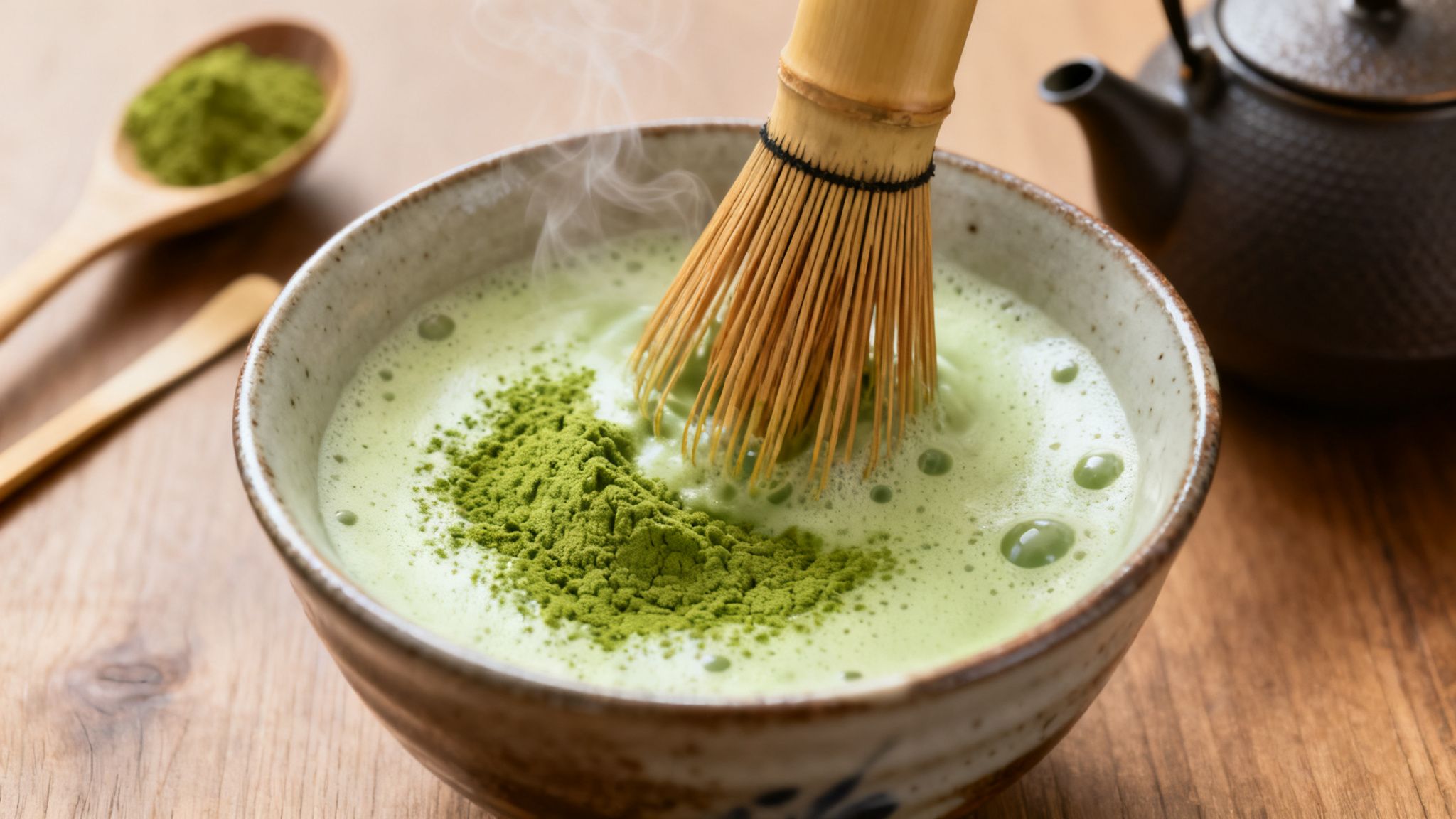
First things first, let's get your tools sorted. While you can get by with household items, using the proper implements really does make for a smoother, more enjoyable ritual.
- A Matcha Bowl (Chawan): You need a wide, flat-bottomed bowl. This gives you plenty of room to whisk properly without splashing vibrant green tea all over the counter.
- A Bamboo Whisk (Chasen): This is the one non-negotiable tool. Its delicate tines are perfectly designed to break up any stubborn clumps and whip up that signature creamy froth.
- A Bamboo Scoop (Chashaku): This traditional spoon is shaped to measure out about one gram of matcha per scoop – just the right amount for a single serving.
The Art of Traditional Usucha Preparation
With your gear at the ready, a perfect bowl is just moments away. Follow these steps, and you’ll get a smooth, frothy, and delicious result every single time.
-
Warm Your Bowl and Whisk: Start by pouring a little hot water into your chawan. Pop the tines of your chasen into the water for about 10 seconds to soften the bamboo. This makes it more flexible and helps prevent it from snapping. Tip out the water and dry the bowl completely.
-
Sift Your Matcha: This is the secret to a clump-free brew, so don't skip it! Use a small, fine-mesh sieve to sift one to two scoops (1-2 grams) of ceremonial grade matcha straight into your warm bowl. Sifting aerates the powder, making it much easier to dissolve.
-
Add Hot Water: Gently pour about 60ml of hot water over the powder. The ideal temperature is around 80°C (175°F). Whatever you do, don't use boiling water—it will scorch the delicate tea and leave you with a bitter taste.
-
Whisk Vigorously: Here comes the fun part. Hold the bowl steady with one hand and whisk rapidly in a ‘W’ or ‘M’ shape with the other. Try to keep the whisk just off the bottom of the bowl. After about 20-30 seconds, you’ll see a rich, creamy froth with tiny bubbles form across the surface.
This is where you’ll really appreciate a high-quality, stone-milled matcha. The ultra-fine powder suspends perfectly in the water, creating a velvety texture with absolutely no grit.
Crafting a Café-Quality Matcha Latte
Fancy something a bit creamier? Making a café-style latte is just as straightforward. The trick is to create a concentrated matcha 'shot' to start.
Simply follow the steps above, but use a little less water—around 30ml should do it. This will give you a potent, smooth matcha base. Next, steam your favourite milk (oat and almond both work beautifully) until it’s hot and frothy. Pour the steamed milk over your matcha shot, sweeten if you like, and enjoy.
The quality of your whisk makes a real difference for both preparations. To learn more, have a look at our guide to the matcha whisk and holder.
Your Matcha Questions Answered
Once you start to understand just how much work goes into making real matcha, a few questions naturally pop up. From its price tag to its health perks, getting the answers can give you a whole new appreciation for this incredible green tea.
The journey from a tiny leaf to a vibrant powder is painstaking, and every single step has a direct impact on what ends up in your cup.
Why Does Good Matcha Cost So Much?
The premium price of genuine matcha really boils down to its incredibly demanding, hands-on production process. It’s best to think of it less like a mass-produced tea and more like an artisanal craft, built on generations of patience and skill.
There are a few key reasons for the higher cost:
- Shade-Growing: For weeks, the tea plants are carefully shaded from the sun. This requires a huge amount of manual labour and special structures to be built over the fields.
- Hand-Picking: Only the youngest, most tender new leaves are chosen for the best matcha. This slow, selective harvest is all done by hand to guarantee top quality.
- Stone-Grinding: This is probably the biggest factor. Using traditional granite stone mills, it can take a full hour to grind just 30-40 grams of ceremonial grade powder.
This slow, cool grinding method is absolutely vital for preserving matcha’s delicate flavour, bright green colour, and all its nutrients. It’s what makes it a true luxury.
The price reflects the time, skill, and tradition invested in every single gram. It's a direct measure of the commitment to quality, from the shaded fields of Uji to the slow, patient turning of the stone mills.
Is Matcha Really Healthier Than Green Tea?
In a word, yes. Matcha is far more potent than your standard cup of green tea, and it all comes down to how you drink it. When you brew a regular green tea, you’re just infusing the leaves in water and then throwing them away, getting only a fraction of the good stuff.
With matcha, you’re actually drinking the entire leaf, which has been ground into a super-fine powder. This means you get a much higher concentration of all its beneficial compounds, including a powerful hit of antioxidants like EGCG, vitamins, minerals, and the amazing amino acid L-theanine. The special shading process boosts these compounds even further, making matcha a real nutritional powerhouse.
What's the Best Way to Store Matcha?
Matcha is incredibly delicate. Its quality can fade quickly when it’s exposed to light, heat, or air. Storing it properly is crucial if you want to protect your investment and enjoy it at its best.
To keep its fresh flavour and vibrant green colour, you should always keep your matcha in an airtight, opaque container in the fridge. This protects it from oxidation and preserves its best qualities. Once a tin is opened, it’s best to enjoy it within a few months to get that fresh-from-the-mill taste.
Ready to experience the exceptional quality that comes from this meticulous process? The team at Jeeves & Jericho is dedicated to sourcing only the finest, authentic Uji matcha, ensuring every bowl is a true taste of tradition. Explore our premium matcha collection today.