


To prepare matcha, you simply sift the bright green powder into a bowl, add hot water at around 80°C, and whisk vigorously in a ‘W’ or ‘M’ motion until a fine froth appears. This mindful ritual, whether for a traditional Usucha or a creamy café latte, transforms a simple powder into something truly exceptional. The secret lies in using the right tools and technique to unlock its unique, calming energy.
The Art and Ritual of Making Matcha
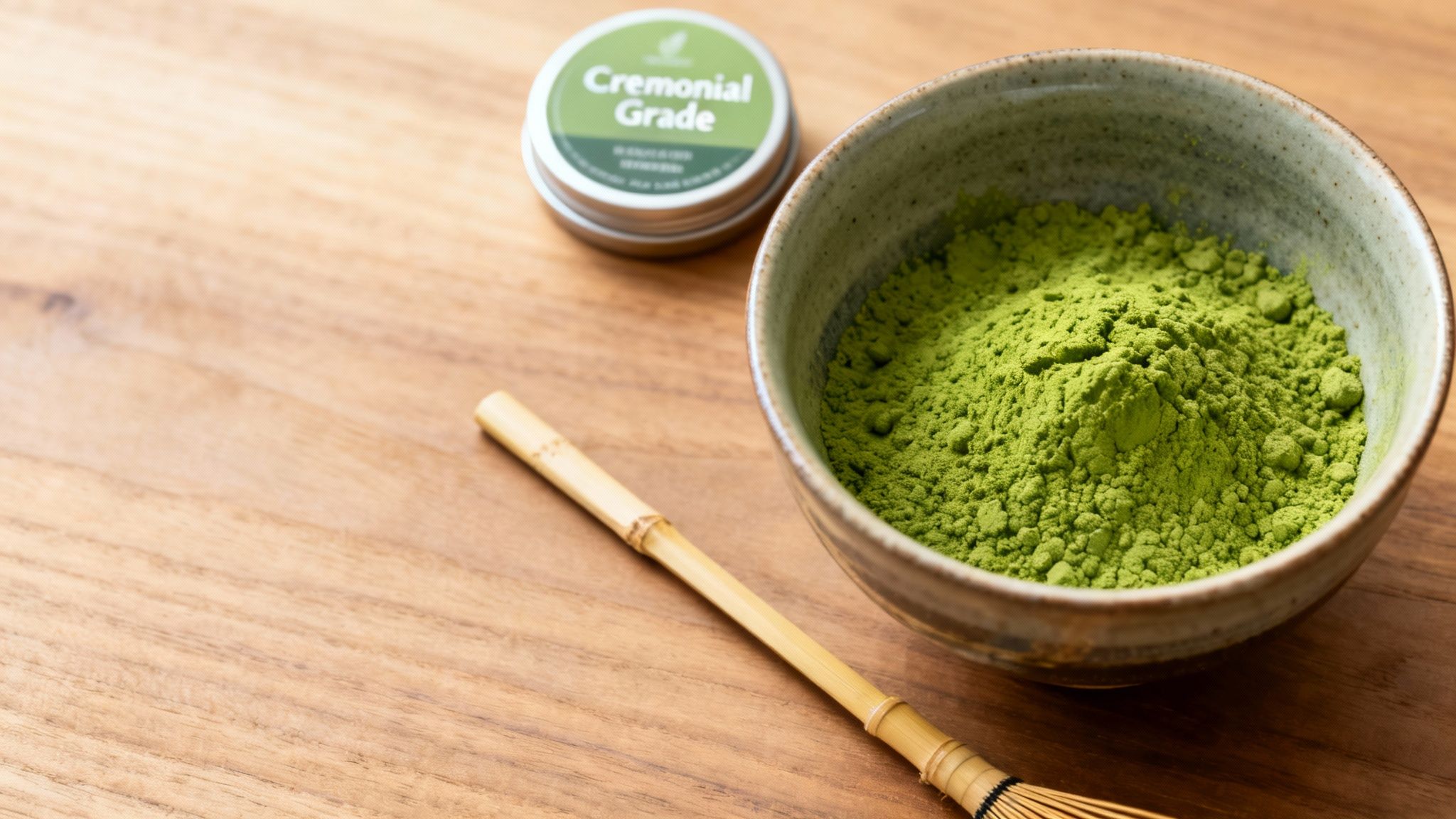
Welcome to the world of matcha. This finely ground green tea powder is deeply rooted in centuries of Japanese tradition, and this guide is your invitation into the mindful practice that makes preparing it so special. It's a process that has captivated tea lovers for generations, from its rich, savoury umami flavour to the unique sense of calm alertness it provides.
To really get to grips with it, it helps to understand where it comes from. You can learn more about what matcha is made of in our detailed article. The process is so much more than just mixing powder and water; it's a moment of focus and intention.
Two Paths to a Perfect Brew
There are two main ways to enjoy this remarkable tea, and each one offers a completely different experience. Knowing the difference will help you choose the right preparation for any moment, whether you're seeking quiet contemplation or a comforting treat.
- Usucha (Thin Tea): This is the traditional, meditative way. You whisk a small amount of high-quality ceremonial grade matcha with hot water to create a light, frothy, and intensely flavourful drink. The whole point is to appreciate the pure taste and aroma of the tea itself.
- Matcha Latte: The modern, café-style favourite. This method starts with a concentrated "matcha shot," which is then combined with steamed milk (dairy or plant-based) and often a touch of sweetener. The result is a creamy, indulgent, and accessible drink that balances matcha's earthy notes with milky sweetness.
At its heart, preparing matcha is an act of mindfulness. Whether you are performing a traditional ceremony or crafting a simple latte, the process encourages you to slow down, focus on the present, and create something beautiful.
The Importance of Quality
Whichever style you choose, the quality of your matcha powder is everything. Seriously, sourcing is paramount. Exceptional, ethically sourced matcha from renowned regions like Uji in Japan, delivers a superior flavour profile, free from the bitterness you often find in lower-grade products.
This guide will equip you with the knowledge to not only prepare matcha beautifully but also to select the finest ingredients for an authentic and rewarding experience every single time.
Assembling Your Essential Matcha Toolkit
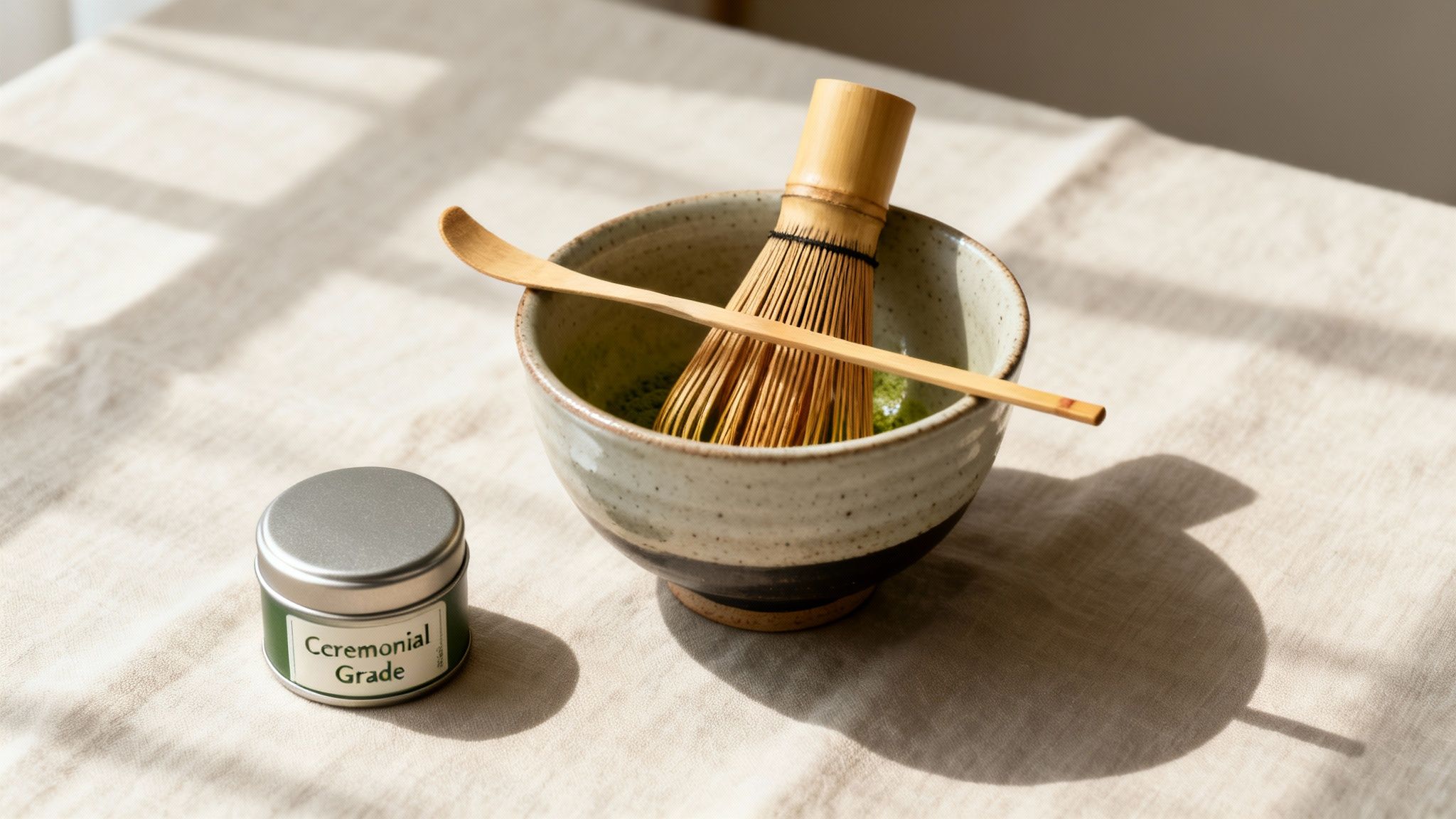
Before you can get to whisking up that perfect bowl of matcha, you need the right gear. Sure, you can improvise, but using the traditional tools not only respects the centuries-old ritual but genuinely makes a world of difference to the final brew. Think of it like cooking – the right utensils just make the whole process smoother and far more enjoyable.
To do it properly, there are three core items that form the foundation of your toolkit. Each one has a very specific purpose, refined over centuries to create that smooth, frothy, and deeply flavourful drink we're all after.
The Three Pillars of Your Matcha Kit
These tools are more than just functional; they’re designed to work in complete harmony. The wide bowl gives the whisk room to dance, and the elegant scoop ensures you measure the delicate powder with just the right amount of care.
-
The Chawan (Matcha Bowl): This isn’t just any old bowl. A proper Chawan has a wide, flat bottom and high, straight-ish sides. This shape is crucial – it gives you plenty of space to move the whisk in that rapid 'W' or 'M' motion needed to create a beautiful froth, all without splashing tea everywhere. A standard cereal bowl is usually too narrow and curved, which really hinders proper aeration.
-
The Chasen (Bamboo Whisk): This is, arguably, the most important tool of all. A Chasen is a delicate instrument carved from a single piece of bamboo, with dozens of fine tines – 80-120 prongs is common for making Usucha (thin tea). These tines are expertly designed to break up clumps and whip air into the tea, creating that signature creamy foam. An electric frother can work for a latte in a pinch, but it just can’t replicate the delicate, nuanced texture a Chasen produces.
-
The Chashaku (Bamboo Scoop): This graceful, long-handled scoop is designed to measure out the perfect amount of matcha powder. One heaping scoop is roughly one gram, so two scoops are the standard for a traditional bowl of Usucha. Its shape lets you gracefully lift the fine powder from the tin to your sifter without making a mess.
Your toolkit is more than just a collection of objects; it’s an invitation to be present. Each piece has its role, turning the simple act of making tea into a moment of focused intention.
Choosing Your Matcha Powder
With your tools ready, the next vital element is the matcha itself. Not all green powders are created equal, and picking the right grade is key to the experience you want. The difference really comes down to two main categories.
Getting to know these grades means you’ll use the right powder for the right job, saving you from a bitter ceremonial tea or a weak-tasting latte.
Ceremonial Grade for Pure Tea
This is the highest quality matcha you can get, made from the youngest, most tender tea leaves harvested in the spring. The leaves are then stone-ground into an incredibly fine, almost talc-like powder.
- Colour: A vibrant, electric green.
- Flavour: Sweet, delicate, and packed with a rich, savoury umami character. It should have absolutely no bitterness when you prepare it correctly.
- Best For: Traditional Usucha, where the matcha is simply whisked with hot water and its pure taste is the star of the show.
Culinary Grade for Lattes and Baking
This grade is made from slightly older leaves harvested later in the season. While still high quality, it has a more robust and slightly more astringent flavour.
- Colour: A more subdued, sometimes yellowish-green.
- Flavour: Stronger and bolder, designed to hold its own against other ingredients like milk, sweeteners, or flour.
- Best For: Matcha lattes, smoothies, ice cream, and baking.
The growing interest in making matcha at home, especially among younger people, has made brilliant quality powders much more accessible. In the UK, over 50% of people under 35 have had a hot matcha drink recently, which is driving a trend where premium powders are the biggest retail sellers.
Caring for Your Tools
A little care will ensure your matcha toolkit lasts for years, becoming familiar companions in your daily ritual. The Chasen, in particular, needs a gentle touch to keep it in good shape.
After each use, simply rinse the whisk thoroughly under warm running water. Never use soap, as the bamboo can absorb it and taint the flavour of your next brew. Gently shake off the excess water and place it on a Kusenaoshi (whisk holder). This ceramic stand isn’t just for looks; it helps the delicate tines dry completely and hold their elegant curve, preventing them from becoming brittle or misshapen. You can find more tips in our guide on how to properly care for your bamboo whisk. Your Chawan and Chashaku just need a quick wash with warm water and a wipe with a soft cloth.
Mastering the Traditional Usucha Method
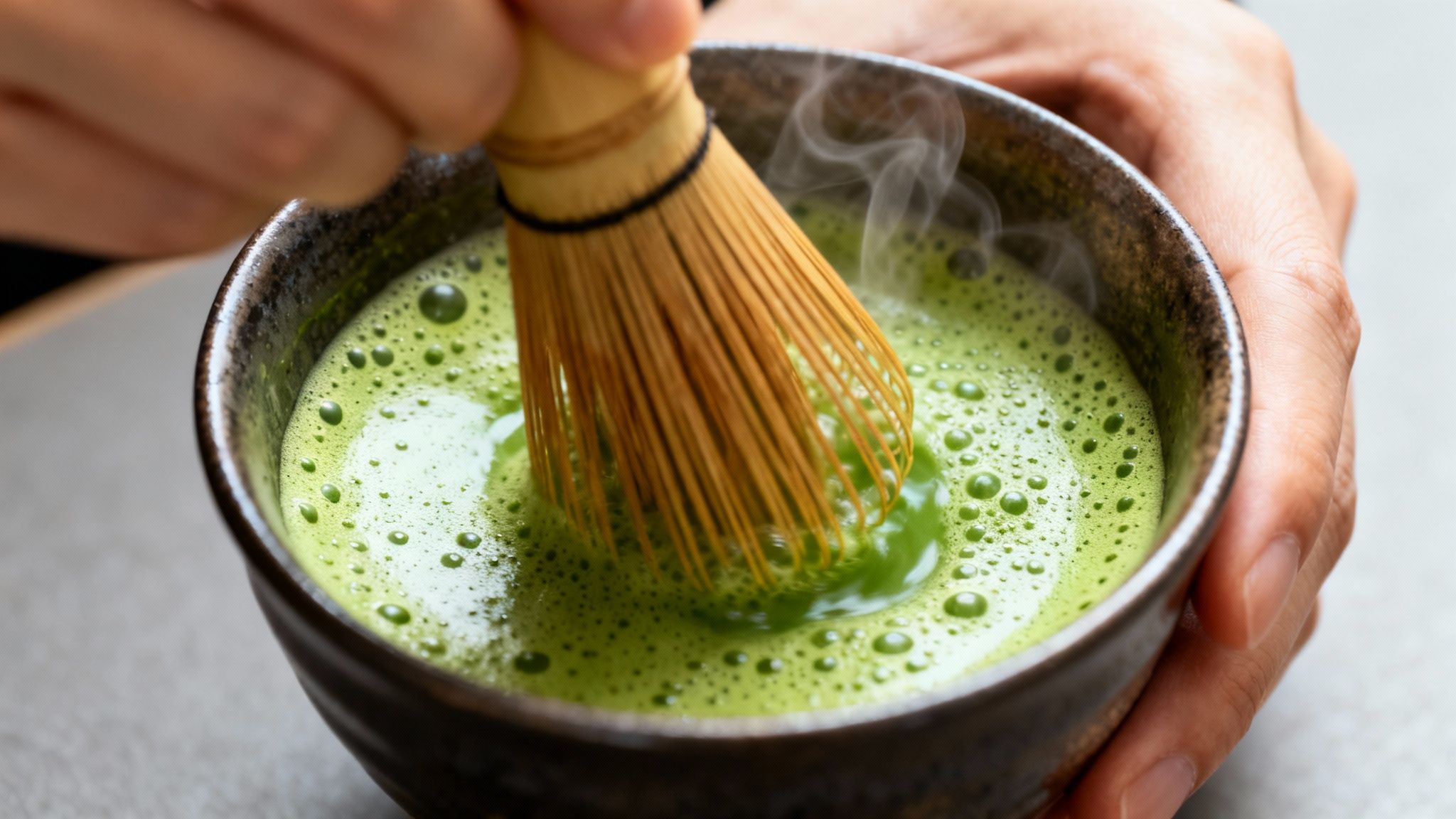
Preparing Usucha, or 'thin tea', is far more than just making a drink; it’s a mindful practice. This is the authentic Japanese method where the pure flavour of the matcha is the star of the show. So, forget any hurried steps—this process is about focus, precision, and carving out a moment of calm in your day.
Every single action, from warming the bowl to that final whisk, directly impacts the quality of the finished tea. By embracing these traditional techniques, you’ll unlock the deep umami notes and delicate sweetness that make a truly great matcha so special. It's a ritual that rewards patience with an incredible tea experience.
Preparing Your Tools and Workspace
Before even thinking about the matcha powder, your first job is to get your tools ready. This initial step is essential for both the pliability of your whisk and the final temperature of your tea. It’s simple, but skipping it is a mistake.
Start by placing your bamboo whisk, the Chasen, into your matcha bowl, the Chawan. Pour hot water over the whisk until the bottom third of the tines are covered. This accomplishes two important things at once.
- It softens the bamboo tines. Soaking the Chasen makes its delicate prongs flexible and resilient, which stops them from snapping during the vigorous whisking to come.
- It warms the Chawan. A pre-warmed bowl is key to maintaining the ideal water temperature when you brew, ensuring your matcha doesn't cool down too quickly and lose its intricate flavour.
Let the whisk soak for about a minute. Afterwards, simply discard the water and gently dry the inside of the bowl with a soft cloth. Your tools are now perfectly prepared.
The Art of Measuring Your Matcha
Precision is absolutely essential when you prepare matcha, and getting the powder-to-water ratio right is fundamental. The traditional tool for this is the Chashaku, an elegant bamboo scoop whose design is about more than just aesthetics; it helps measure the fine powder with care.
Typically, you’ll want two heaping scoops from the Chashaku, which works out to roughly 1.5 to 2 grams of matcha. This is the standard measure for a single serving of Usucha.
The next step is non-negotiable if you want a silky-smooth tea: sifting. Even the finest ceremonial grade matcha can form tiny clumps from static or humidity. Trust me, trying to whisk these away once you’ve added water is nearly impossible and leads to a gritty texture. To avoid this, pop a small, fine-mesh sieve over your warmed Chawan and gently push the two scoops of matcha through it with the back of your Chashaku. This aerates the powder, breaking up lumps and guaranteeing a flawless, velvety consistency.
Sifting isn't just a suggestion; it's the secret to achieving a completely smooth, lump-free bowl of matcha. This one action elevates your tea from good to exceptional, guaranteeing a perfect suspension of powder in water.
Achieving the Perfect Water Temperature
Water temperature is arguably the most critical variable in unlocking matcha’s true flavour. If your water is too hot—boiling water is the main culprit—it will scorch the delicate tea particles. This results in a bitter, astringent taste that completely masks the beautiful umami and sweetness you’re looking for in a high-quality matcha.
The ideal temperature is 80°C (176°F). It’s hot enough to dissolve the powder and release its complex aromas, but cool enough to preserve those delicate, sweet notes.
Don't have a temperature-controlled kettle? No problem. It's simpler than you might think.
- The Boil and Wait Method: Bring your water to a full boil, then take it off the heat. Let it cool for 2-3 minutes before pouring. This usually brings it down to the right temperature range.
- The Transfer Method: Pour boiling water from your kettle into a separate cup first. Then, pour it from that cup into your Chawan. Each transfer causes the water to lose about 10°C, bringing it neatly into the ideal zone.
Once your water is ready, pour approximately 60-70ml over your sifted matcha powder. Now, you’re ready for the most iconic part of the process.
Mastering the Whisking Technique
The final, and most active, stage is the whisking. The goal here isn't to stir, but to rapidly agitate the mixture, suspending the tea particles evenly in the water and creating a beautiful layer of fine, creamy froth. This requires a specific motion and a relaxed but firm grip.
Hold the Chawan steady with one hand and grip the Chasen with the other, keeping your wrist loose. The power should come from your wrist, not your whole arm. Lower the whisk into the tea so the tines just touch the bottom of the bowl.
Begin whisking in a rapid, energetic pattern, tracing the letter 'W' or 'M' back and forth across the bowl. You want to move as quickly as you can for about 20-30 seconds. You should hear the tines lightly scratching the bottom—that’s a good sign you're incorporating plenty of air.
As a fine, jade-coloured foam begins to form, gradually raise the whisk towards the surface. Continue the 'W' motion but focus on whisking just the top layer to break up any larger bubbles and create a smoother, more uniform crema. For the final flourish, slowly trace a circle around the edge of the bowl with the whisk and lift it from the centre. This will leave a beautifully formed peak of foam right in the middle.
Your Usucha is now ready. It’s best enjoyed immediately, while the froth is at its peak and the temperature is perfect. Drink it directly from the bowl in three or four sips, savouring the rich, complex flavour and the mindful effort you put into it.
Creating the Perfect Café-Style Matcha Latte

While the Usucha ceremony is a beautiful, mindful ritual, sometimes you just want the creamy, comforting hug of a great matcha latte. This modern take has swept the globe, offering a more indulgent and accessible way to enjoy matcha's unique flavour. And the best part? It's endlessly customisable.
The trick to a truly exceptional latte isn't simply pouring milk over tea; it's about building layers of flavour and texture. Everything hinges on creating a potent, smooth "matcha shot"—the vibrant green heart of your drink. Get this foundation right, and you'll be crafting lattes that are better than anything from your local coffee shop.
Building Your Matcha Shot
Think of your matcha shot as the equivalent of an espresso shot. It’s a concentrated, intensely flavoured base that won’t get lost when you add milk and maybe a touch of sweetness. A good Culinary Grade matcha is perfect here, as its more robust profile is designed to shine through.
The process is similar to making Usucha, just with a bit less water.
- Sift your powder. Add 1 teaspoon (about 2 grams) of Culinary Grade matcha through a fine-mesh sieve into your Chawan or a small bowl. This is a non-negotiable step for a silky, clump-free texture.
- Add a splash of hot water. Pour just 30-40ml of hot water, ideally around 80°C (176°F), over the sifted powder.
- Whisk it good. Grab your Chasen (bamboo whisk) or a handheld electric frother and whisk like you mean it. A rapid 'W' or 'M' motion works best until the matcha is fully dissolved and a light froth appears. You’re looking for a thick, vibrant green liquid with the consistency of double cream.
With your shot ready, you're all set to build your latte.
Choosing the Perfect Milk Partner
The milk you choose completely changes the final drink, so it’s well worth experimenting to find what you love. Each one interacts with matcha's complex notes in its own way.
- Oat Milk: There's a reason this is the café standard. Its natural creaminess and subtle sweetness are a perfect match for matcha's grassy notes, and it froths like a dream.
- Cow's Milk (Whole): For a rich, velvety texture and a classic latte experience, you can't beat whole milk. The fat content and natural sweetness balance matcha’s slight bitterness beautifully.
- Almond Milk: A popular dairy-free alternative, almond milk brings a lighter body and a nutty flavour that adds an interesting twist. Look for barista blends, as they’re made to froth better.
- Soya Milk: With its distinct flavour and high protein content, soya milk creates a fantastic, dense foam. It’s another brilliant plant-based option, especially if you fancy trying your hand at latte art.
Thankfully, the soaring popularity of matcha in the UK means we're spoilt for choice with high-quality powders and plant-based milks. The UK matcha market was valued at around USD 219.6 million and is set to keep growing, largely thanks to health-conscious drinkers and constant innovation. You can dive deeper into the expanding UK matcha market on marketresearchfuture.com.
The ideal milk for your matcha latte is a personal choice. Don't be afraid to experiment with different types—from creamy oat to nutty almond—to discover the combination that best suits your palate.
Achieving That Velvety Foam
That silky foam is what separates a good latte from a great one. The aim is to create "microfoam"—a texture made of tiny, uniform bubbles that feels smooth and velvety, not stiff and bubbly.
Using a Handheld Frother
This is the easiest way to get great results at home.
- Gently heat your milk in a saucepan or jug until it's steaming, but not boiling (around 65°C / 150°F).
- Pop the frother head just below the surface of the milk.
- Turn it on and gently move it up and down to pull in air until the volume has increased by about a third. You’ll know it’s ready when it looks silky and smooth.
Using a Steam Wand
If you have an espresso machine, you can create café-quality foam.
- Fill your milk pitcher about a third of the way with cold milk.
- Place the steam wand just below the surface and turn it on. You want to hear a gentle hissing sound as the milk "stretches".
- Once the milk has expanded, dip the wand deeper to heat it through until the pitcher is hot to the touch. Give the pitcher a firm tap on the counter and a swirl to mix the foam in.
Sweetening and Serving Your Latte
Now for the final assembly. Pour your concentrated matcha shot into your favourite mug. If you’re sweetening it, now’s the moment to stir in your choice—maple syrup, honey, or agave nectar all blend in beautifully.
Finally, slowly pour your frothed milk into the mug. If you want to get creative, hold back the foam with a spoon as you pour, then dollop it on top to create some simple latte art. A tiny dusting of extra matcha powder on top makes for a beautiful finish. Enjoy it straight away.
Keeping Your Matcha at Its Best
Once you’ve got your hands on some beautiful, vibrant matcha, you’ll want to keep it that way. Think of it less like a dry pantry staple and more like a fresh herb. It’s a delicate powder, and its biggest foes are light, air, heat, and moisture.
Let any of these get to your matcha, and you’ll quickly find its brilliant green colour, fresh aroma, and rich umami flavour will fade, leaving you with a dull, bitter powder. Not what we want.
The best way to protect it is simple: keep it in an airtight, opaque container. The little tin your matcha often arrives in is perfect for the job. Just pop it in a cool, dark cupboard, well away from the oven, hob, or any sunny windowsills.
To Chill or Not to Chill?
Popping your matcha in the fridge can be a good shout for keeping it fresh longer, especially if you've bought a big tin. But there's a catch – condensation. Moisture is the absolute enemy of matcha, causing it to clump and ruining its delicate flavour.
If you are going to refrigerate, there's one golden rule you must follow:
- Let the sealed tin come all the way up to room temperature before you open it. This stops any condensation from forming inside and wrecking the powder.
- This trick is really only for an unopened tin. Once you've cracked it open, it's far better to just keep it in a cool cupboard to avoid the constant temperature changes.
We’ve got a few more tips and tricks in our guide to the proper storage for tea.
You'll know your matcha has seen better days if its colour has changed. If that once-vibrant green has faded to a muddy, yellowish-brown, it means the powder has oxidised. It’s not going to taste great.
Finding Quality Matcha
Knowing how to whisk up a good bowl is one thing, but starting with a high-quality powder is just as important. The very best matcha tends to come from specific regions in Japan, with Uji, near Kyoto, being the most famous for its centuries of expertise and perfect growing conditions.
Look for suppliers who work directly with the farmers in Japan. It’s this kind of transparency that not only means you're getting the real deal but also helps support ethical and sustainable farming. When you're browsing, keep an eye out for quality options like Zuma Matcha Green Tea Powder. Being able to trace your matcha back to its source is always a sign of great quality.
Thankfully, it's easier than ever for us here in the UK to get our hands on the good stuff. Online shops have become a brilliant way to buy ethically sourced, single-origin matcha, connecting us directly with brands that care about where their tea comes from. It puts the power in your hands, so you can be sure every bowl you make is a truly exceptional one.
Common Questions About Preparing Matcha
Let's be honest, even with the best intentions, your first few bowls of matcha might not be picture-perfect. It happens to everyone. Most newcomers run into the same couple of snags, but the good news is that the fixes are usually incredibly simple.
Once you know what to look out for, you’ll be making beautiful matcha with confidence.
Why Is My Matcha Lumpy and Not Frothing?
Clumps. They're the most common frustration and almost always caused by a bit of static or moisture getting into the fine powder. The single most effective trick in the book? Sift your matcha through a fine-mesh sieve before you add a drop of water. It takes seconds, but this one action aerates the powder and is your ticket to a silky-smooth brew.
If you’ve sifted but still aren't getting that signature frothy layer, a few other things might be going on:
- Water Temperature: If your water is on the cooler side, the powder just won't dissolve properly. That 80°C sweet spot really is key.
- Whisking Technique: A gentle stir won’t do it. You need a brisk, energetic ‘W’ or ‘M’ motion, driven from the wrist, not the arm. This is what whips air into the tea and builds that lovely foam.
- The Wrong Ratios: Too much water will dilute your efforts, making it nearly impossible to create a good froth. Stick closely to the recommended measurements to give yourself the best chance.
If there’s one secret to a perfect bowl, it’s in the prep. Sifting the powder and getting your water temperature right will solve most texture and froth issues before they even start.
Can I Prepare Matcha Without a Bamboo Whisk?
While the traditional bamboo whisk, or Chasen, is purpose-built for the job and will always give you the best results, you're not completely out of options without one.
Your next best bet is a small, handheld electric milk frother. It does a surprisingly good job of blending the powder and creating foam, making it a fantastic modern substitute, particularly if you're making lattes.
In a real pinch, you could try shaking the matcha and water together vigorously in a tightly sealed jar. What you should avoid, however, is a standard kitchen whisk or a spoon. These tools just can't move fast enough to break up the powder effectively or generate that delicate, uniform froth that makes a bowl of matcha so special.